
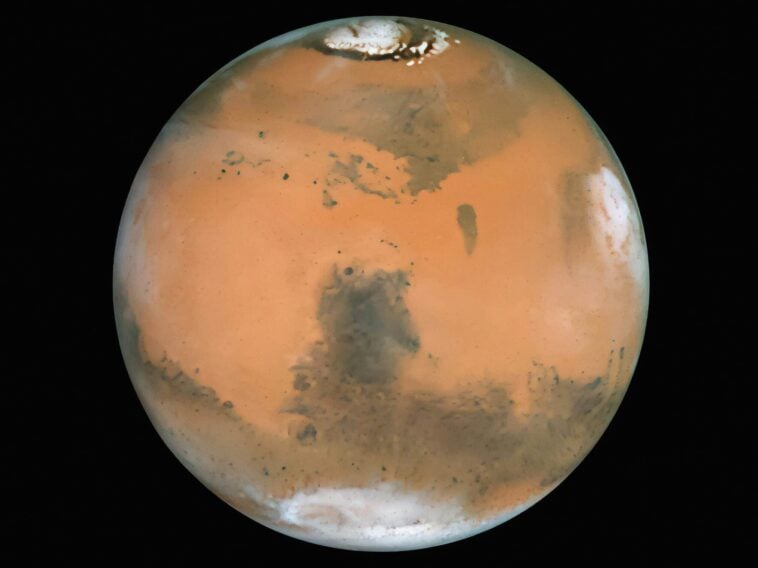
Nuclear spaceship is now on NASA’s actual roadmap with a launch target before the end of the decade. The agency just unveiled plans for SR-1 (Space Reactor-1 Freedom), a nuclear-powered spacecraft designed to travel to Mars faster and more efficiently than anything we’ve built before.
If it works, it could completely change how humans move through space. Faster trips, longer missions, less reliance on sunlight. Basically, a whole new playbook.
Here is all you need to know about the plan.
Rockets got us to space but we can go further with nuclear
Right now, most spacecraft run on chemical propulsion. It works but it’s not exactly efficient for long-distance travel.
Nuclear propulsion changes the equation completely. Instead of burning fuel the traditional way, a nuclear reactor generates massive amounts of energy and uses that to power the spacecraft. More energy per kilogram, more efficiency, and longer range.
As Simon Middleburgh, co-director of the Nuclear Futures Institute at Bangor University in Wales, put it, “you get more bang per kilogram.”
Another kicker is that as you double your distance from the sun, you don’t just get half the power-you get a quarter. For a Mars mission, that makes solar panels massive and unwieldy. Nuclear provides a “constant-on” battery. Solar power works great near Earth, but the farther you go into space, the weaker it gets. Nuclear, on the other hand, doesn’t have that problem.
How does a nuclear spaceship actually work?
This isn’t about explosions or anything dramatic like that. NASA’s approach uses nuclear electric propulsion (NEP), which is less about brute force and more about consistency.
The simple version is that a nuclear reactor generates heat, that heat becomes electricity, and electricity powers a propulsion system that pushes the spacecraft forward.
It’s low thrust but extremely efficient. Think of it like slow and steady but unstoppable over long distances. So while chemical rockets are like a drag racer—huge burst of speed that burns out in minutes—NEP is like a high-end electric car with an infinite battery. It starts slow, but because it never has to stop “stepping on the gas,” it eventually leaves chemical rockets in the dust.
If SR-1 works out, it could make trips to Mars faster, more efficient, and safer for astronauts, with less time exposed to radiation. Right now, one of the biggest risks of going to Mars is how long astronauts have to stay in space. Cut the travel time, and that risk is reduced.
As for the design, early concepts suggest SR-1 will look like a massive arrow in space. A uranium-powered reactor at the front and propulsion systems at the back.
On the sides, there are giant radiator fins to dump excess heat. That bit is critical, as the whole thing could literally overheat in space without those radiators.
Space race energy is back
NASA wants this ready by 2028. That means hardware development starts soon, assembly and testing by early 2028, and launch by the end of that same year.
For context, space projects usually take way longer. But given the quiet and not-so-quiet space race happening again, it’s in the agency’s best interests to move quickly.
The U.S., China, and Russia are all pushing hard on lunar bases, deep-space missions, and nuclear tech in space. Whoever cracks this first gets a serious advantage. And nuclear propulsion is one of the biggest unlocks on the board.
Source: MIT Technology Review