
To determine whether astronauts could one day live in lunar caves, NASA has selected three new science missions through its PRISM program (Payloads and Research Investigations on the Surface of the Moon).
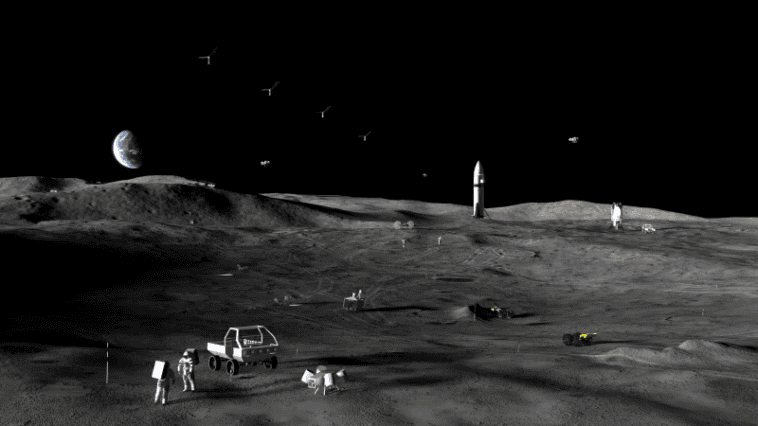
These missions serve as vital scouts for the Moon Base Program, a broader NASA effort to establish a permanent, habitable lunar outpost at the Moon’s South Pole beginning in the early 2030s.
How NASA plans to prep the lunar surface
Commercial landers will deliver the three payloads to the surface under NASA’s CLPS (Commercial Lunar Payload Services) initiative, which hires private companies to build and operate robotic landers, laying early groundwork for the Moon Base Program.
“NASA Science is building the ultimate interplanetary survival guide to ensure that science goes first to the lunar surface to provide our future astronaut crews with the vital information, resources, and safety precautions needed ahead of time to survive the night on the Moon,” said Nicky Fox, who heads NASA’s Science Mission Directorate, in a statement.
The cave hunt mission is called GIMLI (Geophysical Instruments for Marius Lunar pit Investigation). It will study the Marius Hills Pit, a lunar surface hole that may lead into a long lava tube. The tubes in question form when the top of a lava flow hardens and the molten rock underneath drains out, leaving a hollow passage behind.
The mission is led by Dr. Nathaniel Putzig of the Planetary Science Institute, a planetary geophysicist known for his work in using radar to map buried water ice and subsurface structures on Mars.
A tube like that would make for a decent shelter because the Moon’s surface swings between extreme heat and cold, takes a steady hit of radiation, and gets peppered by tiny space rocks, hazards that ease considerably once underground.
Ice is the second target. The DISCO (Depth Imager with Spectral and Color Optics) instrument will take the first direct measurements from the surface of ice tucked inside micro-cold traps, small patches that never see enough sunlight to warm up. Because hauling water from Earth is expensive, the ice already on the Moon could be turned into drinking water, oxygen, or hydrogen. The same instrument will also examine how landing rockets blast dust around and how stable the ground is underfoot.
Dr. Ariel Deutsch of NASA’s Ames Research Center, a planetary scientist and veteran of the Artemis II Lunar Science Team, heads the mission.
The third mission, LEMS-SP (Lunar Environment Monitoring Station – South Pole), will sit near the South Pole as a long-term watchdog. It will log micrometeoroid strikes, which the Moon’s thin atmosphere does almost nothing to stop; record moonquakes with a seismometer, while its other sensors will track gases in the faint lunar atmosphere.
The mission is led by Dr. Mehdi Benna of the University of Maryland, Baltimore County, a veteran researcher specializing in the dynamics of planetary exospheres.
Brad Bailey, director of NASA’s Exploration Science Strategy Integration Office, frames the project as the bridge to the future. “These investigations exemplify how Artemis and Moon Base are expanding the frontier of lunar exploration, advancing innovative technologies, deepening our understanding of the Moon’s environment, and paving the way for future astronaut missions,” Bailey noted.
NASA has yet to announce the launch dates for any of the three payloads.
Sources: NASA, Planetary Science Institute, Moon Base Program (NASA), Science Daily