
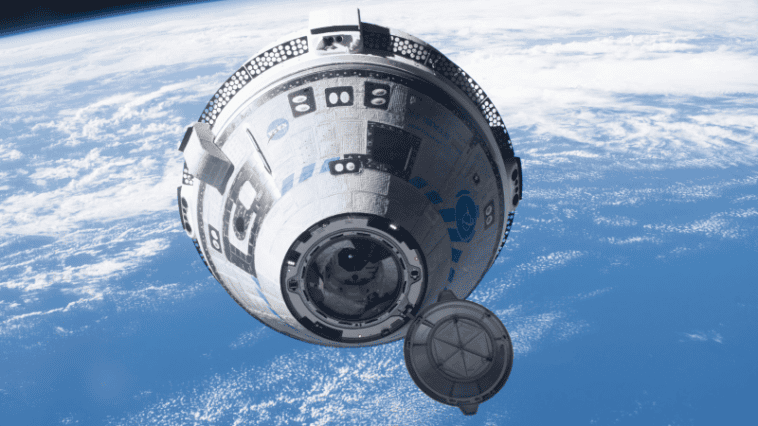
NASA on Monday confirmed that Boeing’s Starliner is grounded for astronauts until 2028. The next flight, Starliner-1, will go up uncrewed in December 2026 or January 2027, with a crewed mission set for around the middle of 2028, a schedule set by what went wrong the last time people flew it.
Boeing’s CST-100 Starliner reusable crew capsule hasn’t carried people since June 2024, and that ride was rough. Suni Williams and Butch Wilmore signed up for about ten days at the space station. Helium leaked on the way. Five service-module thrusters failed during the approach to the station, and a separate crew-module thruster issue occurred on descent.
NASA looked at all that and sent the capsule back without them, leaving the two astronauts stuck up there for more than nine months until a SpaceX Dragon could bring them down in March 2025.
By February 2026, the agency had slapped the mission with a “Type A mishap” label, the worst it gives out.
The leaks turned out to be a seal problem. The oxidizer in Starliner’s propulsion system had been wearing them down. Boeing switched materials and went up a size.
“Boeing has implemented all of those changes on the Starliner-1 spacecraft already,” said Dana Weigel, NASA’s Low Earth Orbit Program manager, during a NASA and Boeing media teleconference briefing held at the Kennedy Space Center recently.
Corrosion is the leading theory for the thruster that failed during descent. Leftover hydrazine fuel reacted with carbon dioxide in the air to form an acid that ate into stainless steel. Now Boeing’s fix involves flushing the thrusters out between missions and keeping them purged, so there’s no fuel left to sit and react.
Some repairs have to wait until after the Starliner-1 mission is complete, which is the primary reason for the long gap before the next crewed flight. Additionally, Boeing must complete the installation of new crew module thrusters and upgraded batteries and finalize parachute system improvements before the vehicle can be certified for the crewed Starliner-2 mission in 2028.
NASA veteran Woody Hoburg will command Starliner-2. His crewmates have yet to be named.
Hoburg is bullish on the vehicle. “I’ve flown many types of aircraft. And let me tell you, Starliner is a pilot’s spacecraft,” the engineer said.
The rocket is the bigger unknown. Atlas V has flown every Starliner mission so far, but it’s out of production, and only six of the boosters remain in ULA’s (United Launch Alliance) inventory, all of them already committed to Starliner missions. After that, the capsule will switch to ULA’s Vulcan Centaur, which still needs clearance to carry people.
Weigel put the combined cost of the spacecraft upgrades and Vulcan certification at $359 million. NASA is chipping in. SpaceX, meanwhile, is flying as if nothing happened. Crew-13 goes up Thursday, and NASA just handed the company $946 million for three more station missions before 2030.
Sources: NASA, Starliner Mishap Report (NASA), SpaceX Award (NASA), Space