
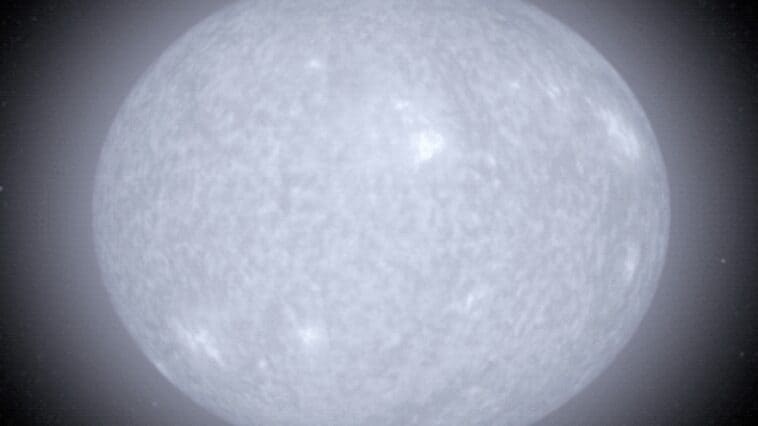
Astronomers may have found an exoplanet orbiting in the habitable zone of a star far hotter than the Sun, though they put the chance that it exists at only slightly better than even.
The star, HD 156295, lies about 140 light-years from Earth. Its surface temperature reaches roughly 13,500 degrees Fahrenheit, compared with about 9,900–10,000°F for the Sun, and it is twice as large and nine times as luminous. The star is also bright enough to be seen without a telescope.
The candidate world, HD 156295 b, orbits at a distance where liquid water could, in principle, exist, according to a recent paper published in the Astrophysical Journal detailing the discovery.
The study was led by Logan Wilson, a Harvard undergraduate who did the work during a research internship at the University of Hawaiʻi’s Institute for Astronomy, working with astronomers there, including Benjamin Shappee, Daniel Hey, and Daniel Huber.
“If this planet turns out to be real, HD 156295 would be the hottest star known to host an exoplanet in its habitable zone,” according to AAS Nova, the American Astronomical Society’s research digest.
The planet itself would be nothing like Earth. Researchers estimate it is a gas giant about 6.3 times the mass of Jupiter, orbiting about 3.9 AU from its star, which is roughly four times the Earth–Sun distance. A single orbit takes about 2,200 days, close to six Earth years.
Researchers arrived at the candidate by examining data on around 16,440 Delta Scuti stars, a class of stars whose brightness rises and falls on a regular cycle, using observations from NASA’s Transiting Exoplanet Survey Satellite. From that group, they narrowed the search to nine systems. Eight appear to host brown dwarfs, objects heavier than any planet but too light to burn hydrogen as stars; one, HD 156295, may host the planet.
To look for planets, the team relied on a method known as pulsation timing. When a planet orbits a pulsating star, its gravity pulls the star slightly back and forth, which makes each pulse of light arrive a little early or a little late. HD 156295 pulses regularly enough that researchers could detect that kind of variation in its timing.
The signal is not strong enough to confirm the planet: the researchers themselves estimate the probability that HD 156295 b is real at just over 50 percent.
Even so, confirmation would still be notable. Of the roughly 6,300 exoplanets identified so far, only a small fraction orbit hot, bright A-type stars like HD 156295.
Sources: The Astrophysical Journal, AAS Nova, NASA Exoplanet Archive, NYP, Science Alert