
Quantum teleportation may sound like science fiction, but a new breakthrough could bring the technology another step closer to practical use. Researchers have developed and experimentally demonstrated a new way to identify a difficult type of multi-photon entanglement known as a W state, solving a challenge that had remained open for more than 25 years. The advance could make complex quantum systems easier to measure and potentially improve future technologies for transferring quantum information. Read on to discover how the researchers cracked the long-standing problem and why their work could matter for the future of quantum teleportation.
The power of quantum entanglement
At the heart of this breakthrough is quantum entanglement — a phenomenon so strange that Albert Einstein famously doubted it. In simple terms, entanglement links light particles (photons) together so deeply that they act as a single unit, no matter how far apart they are.
Instead of treating each particle individually, scientists must view the entire system as one connected network. While this idea defies everyday logic, it is a key building block for next-generation quantum computing, ultra-secure communication, and information transfer.
Solving a 25-year bottleneck
To build functional quantum networks, scientists do not just need to entangle photons; they must also quickly verify which type of entangled state they have created.
Traditionally, researchers used a method called quantum tomography. The problem? It works like assembling a massive jigsaw puzzle by taking thousands of individual measurements. Add just a few extra photons, and the required data explodes exponentially, creating a massive bottleneck.
To bypass this slow process, scientists use “entangled measurements”, a shortcut that identifies the quantum state in a single step. While researchers mastered this one-shot trick decades ago for a common configuration called the GHZ state, a second major type known as the W state remained impossible to measure directly.
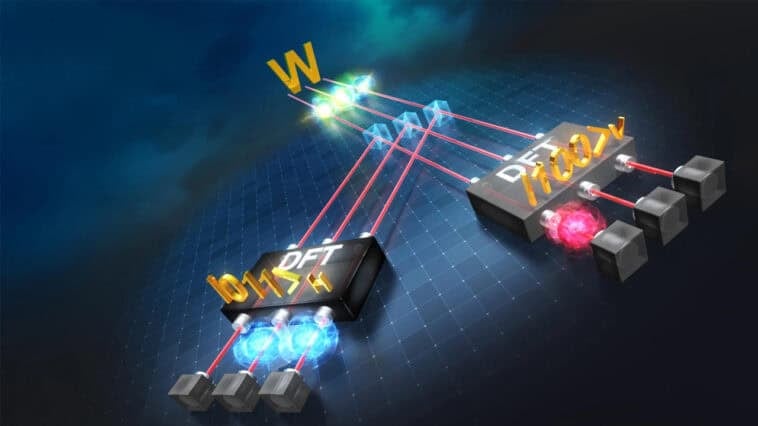
That is, until now. Researchers at Kyoto University and Hiroshima University have successfully built a device that identifies W states in one go.
“More than 25 years after the initial proposal concerning the entangled measurement for GHZ states, we have finally obtained the entangled measurement for the W state as well, with genuine experimental demonstration for 3-photon W states,” says corresponding author Shigeki Takeuchi.
How the new shortcut works
To solve the puzzle, the team took advantage of a natural pattern in W states called cyclic shift symmetry. Imagine a ring of lights where shifting the position of each bulb preserves the overall light pattern—photons in a W state share a similar mathematical balance.
Using custom optical circuits, the team designed a system that reorganizes quantum information to highlight these hidden patterns. When they tested the device with three individual photons, the circuit successfully recognized and sorted the different W states with high precision and stability.
Crucially, this mathematical shortcut works in theory for W states containing any number of photons, making it a versatile tool for future quantum hardware.
What this means for quantum teleportation
While “quantum teleportation” sounds like sci-fi beam-me-up technology, it actually refers to transferring data across distances without physically moving the matter itself. Instead, entanglement acts as a bridge to copy the quantum information from one spot to another.
By making complex multi-photon states easy to identify, this new technique clears a major hurdle for faster quantum communication, secure data transfer protocols, and advanced quantum computing.
“In order to accelerate the research and development of quantum technologies, it is crucial to deepen our understanding of basic concepts to come up with innovative ideas,” Takeuchi notes.
What’s next?
Having proven the concept with three photons, the research team is now working to scale the technology to larger quantum systems. Their next goal is to shrink these optical circuits onto microchips, making the technology compact, affordable, and ready to power the quantum networks of tomorrow.
Source:
Science Daily