
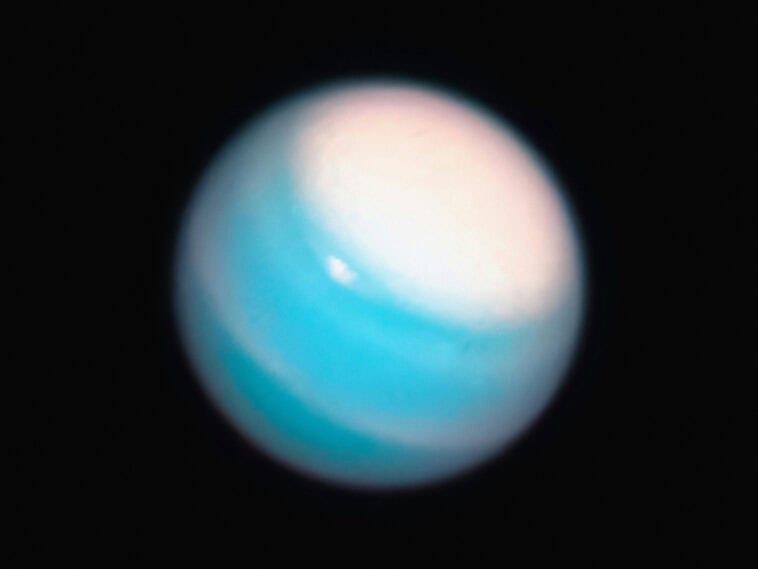
A tiny moon orbiting Uranus may have a substantial ocean buried underneath it. Researchers studying Ariel, one of Uranus’ moons, found evidence that its strange, heavily fractured surface may have been shaped by tidal forces generated when the moon had a much more eccentric orbit. Their findings, published in Icarus, suggest Ariel may have hidden an ocean extending more than 100 miles (170 kilometers) deep beneath its frozen exterior.
For perspective, the Pacific Ocean averages only about 2.5 miles (4 kilometers) deep. This means this little frozen world may have had an ocean roughly 40 times deeper than the Pacific’s average depth.
Meet Ariel
Ariel is the brightest of Uranus’ moons and the second closest to the planet. At about 720 miles (1,159 kilometers) across, it is relatively small compared with many other moons in the Solar System.
Its surface, however, is anything but boring. Ariel is covered in fractures, ridges and grabens, where sections of the crust have dropped below the surrounding terrain. Some of these structures are enormous, while other parts of the surface appear much younger.
Scientists have also spotted smooth regions that may have formed through cryovolcanism — basically volcanic activity on an icy world, where water, ice or other volatile materials erupt instead of molten rock. That mix of ancient craters, younger terrain and giant fractures gave researchers a clue that something interesting may have been happening underneath.
The moon may have been getting squeezed
The new study focused on how Ariel’s interior and orbit could have produced the features visible on its surface. One important piece of the puzzle is orbital eccentricity, which measures how much an orbit deviates from a perfect circle.
Today, Ariel’s orbit is close to circular. But researchers modeled a past in which its eccentricity may have reached about 0.04, roughly 40 times its current value. As Ariel moved closer to and farther from Uranus, the planet’s gravity would have repeatedly stretched and squeezed the moon. Think of Ariel getting gently squished and reshaped over and over again as it traveled around Uranus.
Those tidal forces could have put enormous stress on its icy crust, helping create the giant fractures and ridges we see today.
The researchers modeled those stresses and compared them with Ariel’s actual surface features. Their models suggest an underground ocean was needed to explain the fractures. As planetary scientist Alex Patthoff put it, the moon’s fractures could have required either a very thin layer of ice sitting over a large ocean or a smaller ocean combined with a much more eccentric orbit. Either way, an ocean appears to be part of the equation.
Ariel may not be the only ocean world around Uranus
The Ariel study follows earlier research from the same team on Miranda, another icy moon of Uranus. That work also found evidence suggesting Miranda may once have hosted a substantial subsurface ocean.
The studies raise the possibility that Uranus could have had two ocean worlds hiding among its moons. And scientists still have an incomplete view of both. We have only seen the southern hemispheres of Ariel and Miranda up close. Their northern hemispheres remain largely unexplored. So, future observations could reveal whether the researchers’ predictions about fractures and ridges actually match reality.
A need to go back to Uranus?
Scientists don’t yet know exactly when Ariel’s ocean existed or how long it lasted. A future mission to Uranus could put a lot to the test by imaging Ariel and Miranda’s unexplored regions and looking for the geological features predicted by the research. For now, Ariel joins the growing list of icy worlds that may have had or still have a lot more going on beneath the surface than meets the eye.
Source: ScienceDaily