
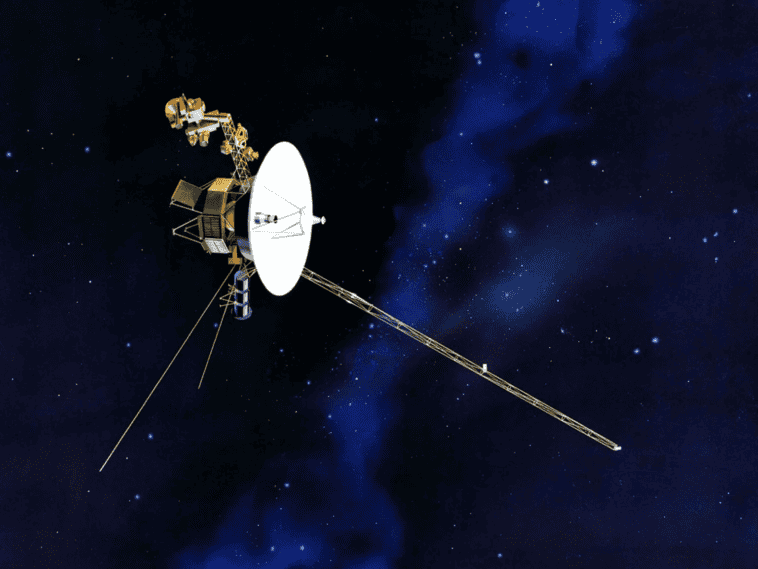
Nearly 49 years after launch, NASA has successfully beamed a new software update to Voyager 2, the legendary space probe that’s now cruising through interstellar space. Nicknamed “Big Bang,” the patch is designed to squeeze every last drop of life out of one of humanity’s greatest explorers, effectively buying the spacecraft another full year of science operations.
The oldest device still getting software support
Think about how stressful it is when your Wi-Fi cuts out in the next room. Now imagine troubleshooting a spacecraft that’s speeding through interstellar space more than 13 billion miles away. That’s essentially what NASA engineers have been doing for decades.
“Big Bang” was designed to help Voyager 2 extend the lifespan of its aging power supply. The spacecraft is powered by a radioisotope thermoelectric generator, which converts heat from decaying plutonium into electricity.
The problem is that after nearly half a century, that power source is running low. Voyager 2 loses roughly four watts of power every year. According to NASA itself, Voyager’s power margins are “razor thin.”
The update bought Voyager 2 another year
The “Big Bang” update didn’t add flashy new capabilities. Instead, NASA shut down certain powered components and replaced them with lower-power alternatives, carefully balancing energy savings with the need to keep the spacecraft warm enough to survive the freezing conditions of deep space.
Without the update, NASA says it would have had to shut down another scientific instrument entirely. Instead, the power savings should allow Voyager 2’s three remaining instruments to continue operating for at least one additional year.
The little sibling that saw more
Voyager 1 gets a lot of attention because it is farther from Earth and famously captured the iconic “Pale Blue Dot” image. But Voyager 2 is arguably the more adventurous sibling. While the former received a gravitational boost that helped it race toward interstellar space faster, the latter took the scenic route. And by “scenic route,” we mean it became the only spacecraft in history to visit all four giant outer planets: Jupiter, Saturn, Uranus, and Neptune.
Voyager 2 is still exploring places nothing else has reached
Voyager 2 has already completed one of the greatest road trips in space history. It is still the only spacecraft humanity has ever sent to Uranus and Neptune, and many of the iconic images we associate with those worlds came from its cameras. Along the way, it discovered new moons, previously unknown rings, and Neptune’s famous Great Dark Spot.
In 2018, Voyager 2 crossed into interstellar space, joining Voyager 1 as the only human-made objects to leave the Sun’s protective bubble and enter the vast space between stars.
NASA plans to perform the same “Big Bang” update on Voyager 1 next. Neither spacecraft will last forever. Their power supply keeps shrinking, and eventually there won’t be enough electricity to operate any instruments at all.