
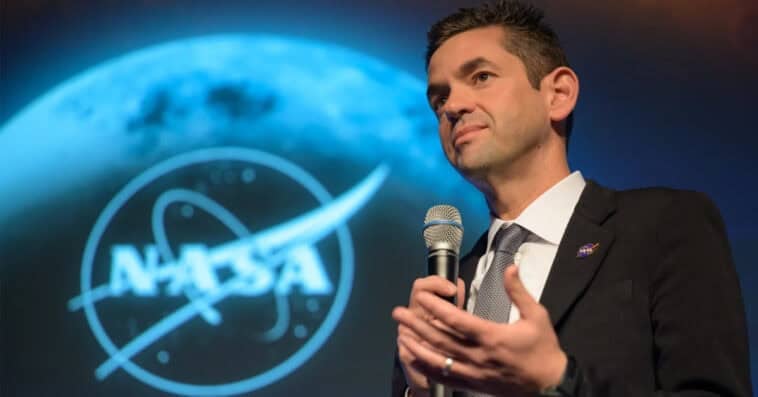
For centuries, humanity has wondered whether we are truly alone in the universe — and now, NASA’s top official believes the answer may be closer than ever. NASA Administrator Jared Isaacman says the odds of discovering alien life are “pretty high,” revealing that the search for extraterrestrial life is a driving force behind many of the agency’s biggest missions. As NASA accelerates its plans for the Moon, Mars, and beyond, the space agency is betting that the next generation of exploration could uncover one of the greatest discoveries in human history.
The search for alien life is a core NASA mission
Isaacman says the search for extraterrestrial life is far more than a scientific curiosity. It is actually one of the driving forces behind many of the agency’s biggest exploration programs.
Speaking during an appearance on CNN’s Meet the Press last April, Isaacman said one of NASA’s most fundamental goals is answering one of humanity’s oldest questions: Are we alone in the universe?
“Investigating the existence of alien life goes to the heart of many things that we do at NASA,” Isaacman said. “Our job here is to go out and try and unlock the secrets of the universe.”
He added that the search for life beyond Earth is woven into nearly every aspect of the agency’s scientific and exploration efforts.
“Are we alone? So I would say that is inherent in every one of our scientific endeavors, our exploration endeavors,” he said.
As part of that effort, Isaacman pointed to NASA’s long-term plans for a permanent base near the Moon’s south pole, where telescopes could one day play a key role in expanding the search for signs of life elsewhere in the cosmos.
Why Isaacman believes the odds are high
Despite his optimism, Isaacman made it clear that he has not personally seen any evidence of extraterrestrial visitors.
Having traveled to space twice, he joked that he “didn’t encounter any aliens up there.”
“I have not seen anything to suggest that we have been visited by any intelligent life forms out there,” he said.
Even so, Isaacman believes the sheer size of the universe makes the possibility of discovering life difficult to ignore.
“When you think about it, we got 2tn galaxies out there. Who knows how many star systems within each of it? I would say the odds that we will find something at some point to suggest that we are not alone are pretty high.”
Building a future on the Moon and beyond
The search for extraterrestrial life is closely tied to NASA’s broader vision of expanding humanity’s presence deeper into space.
Under Isaacman’s leadership, the agency is pursuing ambitious plans that include establishing a permanent lunar base, developing nuclear-powered spacecraft, growing a commercial space economy, and ultimately sending astronauts to Mars.
The Moon is viewed as a critical stepping stone toward those long-term goals. NASA hopes future missions will demonstrate how astronauts can extract water ice from the lunar surface and convert it into oxygen, hydrogen, and rocket fuel — resources that could make future exploration more self-sufficient.
Isaacman, however, acknowledged that the technology is still being developed.
“I don’t know who’s rushing to have the first glass of moon water,” he quipped in a recent interview with the New York Post.
Following the success of the Artemis II mission, NASA is preparing for an aggressive schedule over the next several years.
The Artemis III mission is expected to advance commercial lunar landing systems while deploying robotic landers and rovers to the Moon’s south pole to begin preparations for a permanent human presence.
“The three most powerful rockets in the world are going to launch in a span of about a week. It’s going to be really quite cool,” Isaacman said.
The following Artemis missions are expected to return astronauts to the lunar surface while laying the foundation for increased commercial activity beyond Earth.
Mars could hold the answer
Isaacman believes one of NASA’s greatest discoveries may come from Mars.
He said there is “a very good chance” that samples returned from the Red Planet within the next decade could reveal evidence that microbial life once existed there.
Scientists are also interested in several of Saturn’s icy moons, which are considered among the most promising places in the solar system to search for signs of life beyond Earth.
Racing toward humanity’s future in space
As NASA races to discover whether life exists beyond Earth, Isaacman emphasizes that the urgency isn’t just about answering humanity’s oldest question—it’s also about strategic leadership. With the U.S. competing against China in a high-stakes, modern space race, Isaacman insists America has no intention of falling behind. “We’re not going to lose,” he said.
But beyond geopolitics and the search for alien life, expanding our footprint into the cosmos is fundamentally about safeguarding our future. Establishing permanent habitats on other worlds reduces what Isaacman describes as humanity’s “massive concentration risk on Earth,” ensuring our species, and the scientific quest to unlock the universe, endures even if a global catastrophe threatens our home planet.
Sources:
CNN
New York Post