
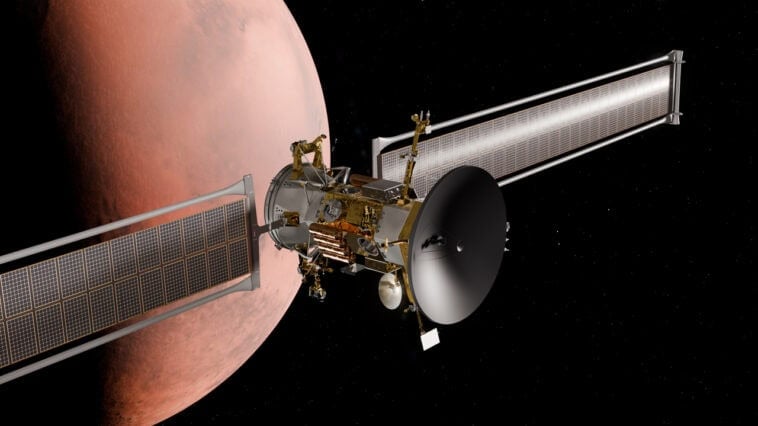
Jeff Bezos’ Blue Origin has landed a $700 million NASA contract that could play a major role in the future of Mars exploration. The company will develop a new telecommunications orbiter capable of relaying science data, images, navigation information and critical communications between Mars missions and Earth. But why does NASA need a dedicated communications network for the Red Planet — and what could this new orbiter mean for the agency’s ambitions on the planet?
NASA’s new Mars communications network
Blue Origin is set to take on a major role in NASA’s plans for Mars after winning the contract to build the agency’s next telecommunications orbiter.
NASA announced on Tuesday, September 1, that it had selected Jeff Bezos’ spaceflight company to develop the $700 million Mars Telecommunications Network (MTN). The network is expected to be operational around Mars by 2030.
NASA described the deal as an important step toward expanding the infrastructure needed for long-term exploration beyond Earth and the moon.
“The award marks a milestone in NASA’s strategy to expand communications and navigation services beyond Earth and the moon, establishing the foundation for sustained exploration of Mars in the coming decades,” the agency said in a statement.
Unlike many spacecraft sent to Mars, however, the new orbiter will not primarily be focused on conducting its own scientific research. Instead, its main job will be to help other missions communicate with Earth.
NASA calls the MTN “a next-generation communications system that will enable reliable, high-bandwidth communications and navigation services for current and future Mars missions.”
Our Mars Telecommunications Orbiter, built upon the Blue Ring platform, will strengthen the communications backbone at the Red Planet while creating new pathways for science. Capable of delivering multiple payloads to the surface and orbits of Mars, it drives discovery today and… pic.twitter.com/nCN8zMAWCk
— Blue Origin (@blueorigin) March 5, 2026
Why Mars needs a dedicated communications system
The need for a specialized communications network is expected to become increasingly important as NASA’s existing Mars infrastructure gets older.
Today, NASA relies on two of its orbiters to relay commands and scientific data between Earth and the Curiosity and Perseverance rovers on the Martian surface. Mars Odyssey, launched in 2001, and the Mars Reconnaissance Orbiter, launched in 2005, perform much of that communications work.
Two European Space Agency spacecraft — Mars Express and the Trace Gas Orbiter — also help relay information.
But all four orbiters have another responsibility: They are conducting scientific research of their own.
The MTN is being designed differently. Rather than splitting its attention between science and communications, the spacecraft will be dedicated to supporting communications and navigation for Mars missions.
That role could become even more important as NASA prepares for increasingly ambitious missions to the Red Planet, including plans that could eventually send astronauts there in the late 2030s or early 2040s.
How Blue Origin won the $700 million deal
NASA’s funding for the project came from Congress in July 2025, when lawmakers approved a budget reconciliation bill that included $700 million for a Mars telecommunications orbiter.
The agency subsequently established its requirements for the spacecraft in February 2026 and issued a formal request for proposals in May.
Blue Origin and Rocket Lab emerged as the leading contenders for the contract, with both companies highlighting their experience and capabilities as they competed for the opportunity.
In the end, NASA chose Blue Origin.
The company plans to build the Mars communications spacecraft around its Blue Ring platform. Blue Origin describes Blue Ring as “an all-in-one, high-powered hybrid solar electric and chemical propelled spacecraft that provides unmatched mission maneuverability, versatility, and capacity at dramatically lower profile costs.”
The platform is designed to provide spacecraft with greater flexibility in maneuvering and operating in space.
Has Blue Ring already reached space?
Blue Ring itself has not yet flown an operational mission, but a prototype version of the spacecraft did reach space during the inaugural launch of Blue Origin’s New Glenn rocket in January 2025.
Although Blue Ring is capable of launching aboard other rockets, the Mars Telecommunications Network could potentially fly on New Glenn. Under the NASA contract, Blue Origin is responsible for the entire mission, including designing, developing, integrating, launching and operating the spacecraft.
The agreement calls for Blue Origin to deliver the Mars telecommunications spacecraft to NASA no later than December 31, 2028.
If everything stays on schedule, the new system could then become operational around Mars by 2030, giving NASA a dedicated communications backbone as it prepares for the next generation of exploration on the Red Planet.
Source:
Space.com