
Mars has surprised scientists once again — and this time, the discovery looks almost too perfectly designed to be natural. NASA’s Curiosity rover has uncovered a vast field of honeycomb-like rock formations unlike anything previously seen on the Red Planet, raising new questions about the ancient conditions that created them. As researchers piece together the story behind these striking geometric patterns, the findings could reshape what we know about Mars’ geological history and the forces that once transformed its surface.
A geometric frontier in Valle Grande
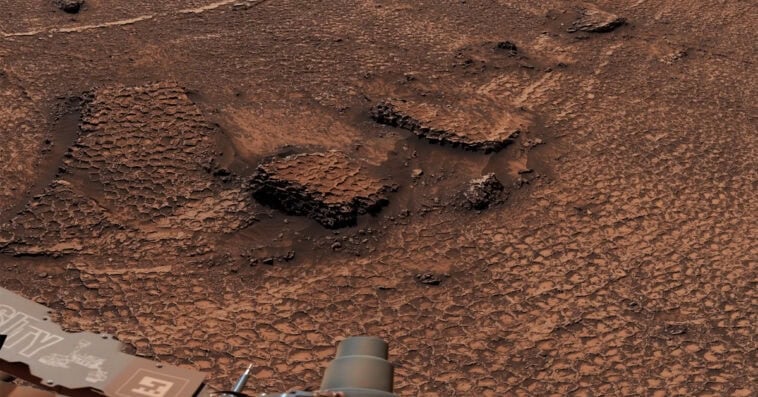
As NASA’s Curiosity rover began its ascent through a Martian valley known as “Valle Grande,” its cameras beamed back a scene that instantly captivated researchers. Etched into the ground was an intricate mosaic of honeycomb-like geometric shapes known as polygonal fractures.
Each shape measures roughly 1.5 to 3 inches across — small enough to fit in the palm of your hand, yet collectively covering vast swathes of terrain. While Curiosity has stumbled upon small clusters of these shapes in past years, the team was unprepared for the sheer volume unveiled in Valle Grande.
On its 4,930th and 4,931st Martian days (or sols) on the Red Planet, Curiosity recorded a full 360-degree panoramic view of the landscape. The resulting imagery showed the geometric carpet extending in every direction, even hugging the slopes of “Miraflores”, a 20-foot-tall, sand-topped rocky outcrop rising above the valley floor.
“We’ve seen a lot of fascinating landscapes through Curiosity’s eyes, but this sea of polygons took our breath away,” said Ashwin Vasavada, Curiosity’s project scientist at NASA’s Jet Propulsion Laboratory. “We measured their shapes and chemistry carefully and are hopeful there are clues in the data as to how these features formed.”
Unlocking the secrets of the Honeycomb
How does a planet end up with a ground covered in neat geometric patterns? Geologists explain that polygonal fractures typically form when surface sediment undergoes repeated cycles of stress, shrinking, and cracking.
On Earth, we see similar phenomena in dry lakebeds or tundra. On Mars, scientists suspect several potential drivers behind the honeycomb shapes:
- Mud cracking: As ancient wet mud dried up under the Martian sun, it naturally contracted and split into repeating geometric networks.
- Thermal shifts: Extreme swings between cold and warmer temperatures over thousands of years may have expanded and contracted the rock surface until it fractured.
- Sediment compression: As layers of dirt piled up on top of ancient mud, intense pressure squeezed out trapped moisture, causing the buried ground to crack as it dried.
By analyzing the chemistry and precise measurements of these Valle Grande fractures, scientists hope to pin down exactly which environmental recipe produced this sprawling field.
Fourteen years of Red Planet revelations
This breathtaking discovery is just the latest milestone for Curiosity, which has been exploring Mars since its historic touchdown on August 5, 2012. Over fourteen years of traversing the Red Planet, the rover has encountered everything from bright sulfur crystals to metallic meteorites resting on the surface.
Yet its most significant achievements stem from its slow climb up Mount Sharp, a majestic 3-mile-high mountain rising from the center of Gale Crater. Billions of years ago, this area was not a frozen desert, but a dynamic landscape of sprawling lakes and rushing streams.
Curiosity’s mission has consistently proved that ancient Mars possessed the necessary liquid water, essential chemical elements, and nutrients to foster microbial life. Beyond water, the rover has previously detected carbon-based organic molecules — the essential building blocks for nucleic acids like RNA and DNA, which carry the code of life as we know it.
While researchers cannot yet confirm whether those organic compounds originated from living microbes or non-biological geological reactions, discoveries like the honeycomb patterns of Valle Grande provide vital context. Every crack and fracture helps scientists piece together how long liquid water persisted, how the climate changed, and whether life ever gained a foothold on our neighboring world.
Source:
NASA