
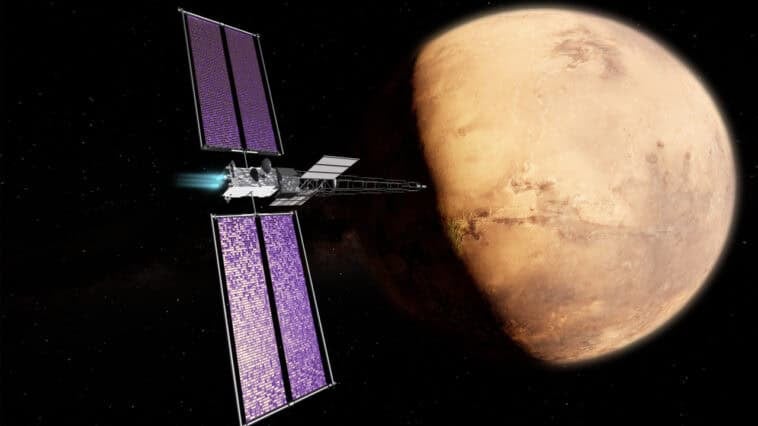
Mars exploration could soon enter a powerful new era as NASA prepares to send a working nuclear reactor toward the Red Planet in late 2028. The ambitious Space Reactor-1 Freedom mission is designed to activate a uranium-fueled reactor in deep space and use its electricity to power an advanced propulsion system, potentially demonstrating technology that could reshape how spacecraft travel across the Solar System. But what makes this mission truly groundbreaking isn’t simply sending a nuclear reactor toward Mars — it’s what NASA plans to do with it once it reaches deep space. Could this nuclear-powered experiment finally unlock a faster, more capable way to explore the Red Planet and beyond?
A 2028 Mars mission with a nuclear twist
NASA’s Space Reactor-1 Freedom, or SR-1 Freedom, is more than a conventional Mars probe. The roughly 12,000-kilogram spacecraft is being developed as a technology demonstrator that could become the first interplanetary spacecraft to use a nuclear fission reactor for propulsion beyond Earth orbit. NASA currently targets a late-2028 launch, with the spacecraft expected to reach the Mars vicinity in 2029.
The mission is still a plan rather than a completed spacecraft waiting on a launchpad. Its purpose is to bring several technologies together in deep space: a fission reactor, a power-conversion system, and electric propulsion. Rather than landing the reactor on Mars, SR-1 Freedom is expected to fly past the planet while deploying its SkyFall payload.
The timing is also important. NASA is targeting December 2028, taking advantage of an Earth-Mars launch opportunity that occurs roughly every 26 months. Missing that window could therefore mean waiting considerably longer for another suitable opportunity.
Why nuclear power changes the equation
Nuclear power in space is not new. Missions such as Voyager, New Horizons, Curiosity and Perseverance have relied on radioisotope power systems that generate electricity from the natural decay of plutonium-238. Those systems are essentially long-lived nuclear batteries and do not rely on a controlled fission reaction.
SR-1 Freedom takes a different approach. Its reactor is designed to use high-assay low-enriched uranium, or HALEU, to produce heat through nuclear fission. A closed Brayton-cycle system would then convert that heat into electricity, with NASA listing an electrical output of about 20 kilowatts.
That would mark an important milestone. The United States previously launched the SNAP-10A fission reactor into Earth orbit in 1965, but it never powered an interplanetary spacecraft. NASA describes SR-1 Freedom as the first spacecraft intended to use nuclear fission propulsion beyond Earth orbit.
From reactor heat to spacecraft thrust
The reactor itself will not push the spacecraft toward Mars like a traditional rocket engine. Instead, its heat will be converted into electricity, which will power an electric propulsion system
SR-1 Freedom is expected to use a Hall-effect thruster. These engines ionize a propellant and accelerate the charged particles using electric and magnetic fields. The result is relatively low thrust, but the system can operate for much longer periods than conventional chemical propulsion, gradually building up the spacecraft’s speed.
That makes nuclear-electric propulsion particularly interesting for deep-space missions. Chemical rockets provide enormous thrust but consume propellant quickly, while electric propulsion sacrifices immediate power for efficiency and endurance.
It is also important not to confuse SR-1 Freedom with nuclear thermal propulsion. A nuclear thermal rocket would heat propellant directly inside a reactor and expel it through a nozzle. SR-1 instead follows the nuclear-electric route: fission produces heat, heat becomes electricity, and electricity drives the thruster
The reactor will not start during launch
SR-1 Freedom is not expected to operate its reactor while leaving Earth. A conventional launch vehicle will provide the initial thrust needed to send the spacecraft onto an Earth-escape trajectory. NASA says the reactor is expected to be activated within 48 hours after launch, once the spacecraft is safely away from Earth.
Once activated, the reactor will have to operate autonomously while managing heat, radiation and power without astronauts nearby to intervene.
A stepping stone toward bigger missions
At roughly 20 kilowatts, SR-1 Freedom’s reactor is nowhere near powerful enough to serve as the energy source for a future crewed Mars spacecraft by itself. NASA has previously considered much larger power requirements for human Mars missions, potentially reaching hundreds of kilowatts or even megawatt levels.
That is why the mission is better understood as a pathfinder. NASA wants real flight experience with reactor control, power conversion, thermal management, radiation shielding and nuclear-electric propulsion before attempting much larger systems.
The lessons could also feed into Lunar Reactor-1, a planned fission surface-power system targeted for the Moon in 2030. Together, the projects are intended to build the technology, workforce and industrial capabilities needed for future nuclear-powered exploration.
The 2028 target still faces major hurdles
A late-2028 launch would be an extraordinary achievement, but the date remains a target rather than a guarantee. NASA still has to complete development and integration, qualify critical hardware, address nuclear safety requirements, finish the SkyFall payload, and secure the necessary launch arrangements.
The Government Accountability Office also noted that NASA is adjusting testing requirements for the propulsion system as it works to keep the program on schedule.
If SR-1 Freedom reaches Mars and successfully operates its reactor-powered propulsion system, the biggest achievement may not be the spacecraft’s journey itself. It would demonstrate that a controlled fission reactor can provide reliable electrical power for propulsion far beyond Earth — and potentially open a new path toward longer, more ambitious missions across the Solar System.
Source:
NASA
Space Daily