
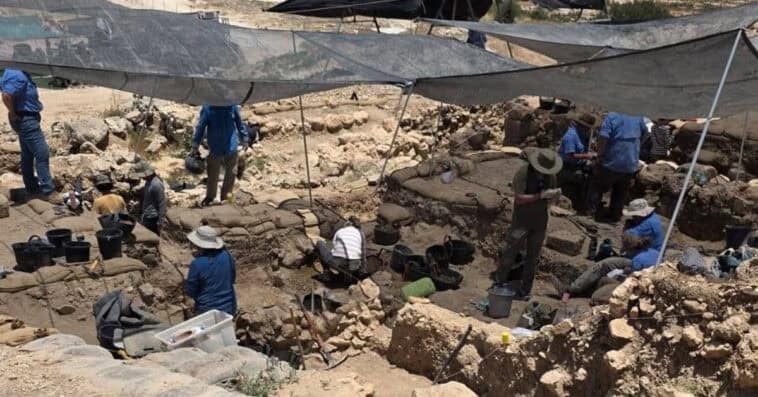
For centuries, historians and treasure hunters have searched for any physical proof of the Ark of the Covenant, one of the most famous lost artifacts in history. Now, a new archaeological study at the ancient site of Shiloh may have finally uncovered its real-world home. Researchers have excavated the foundations of an ancient structure with dimensions and artifacts that closely match the biblical descriptions of the Tabernacle — the tent where the Ark was kept before it vanished. While the golden chest itself has not been found, this discovery provides concrete evidence that the biblical accounts may be historically accurate, raising an exciting question: Does this newly uncovered structure hold the clues needed to solve the thousands-year-old mystery?
Piecing together an ancient blueprint
The search for the Tabernacle has long occupied both historians and theologians. According to the Bible, this sacred sanctuary was the home of the Ark of the Covenant, the gold-plated chest containing the stone tablets of the Ten Commandments. Scripture notes that Moses placed the tablets inside, and the Ark remained the centerpiece of Israelite worship until it mysteriously vanished from the historical record before the Babylonians destroyed Jerusalem in 586 BC.
Now, a team of researchers from the Associates for Biblical Research (ABR) believes they are closer than ever to mapping out exactly where that sacred history took place. Digging at Tel Shiloh, an ancient site in the West Bank known as Israel’s first religious capital, archaeologists have uncovered the missing pieces of a massive, ancient building.
The breakthrough of the current digging season was the discovery of a critical southern wall. By finding this wall, the team can now see the building’s full footprint, which runs precisely from east to west. Remarkably, the size and orientation of these ruins align closely with the setup of the Tabernacle described in the Bible.
While the team initially located parts of this large Iron Age structure in 2025, these new walls significantly strengthen the case that they have found a major religious complex. Dr. Scott Stripling, director of the Tel Shiloh excavation, explained the significance in a blog post for the Bible Archaeology Report:
“The discovery of the southern wall now enables our researchers to reconstruct the full dimensions of the building and better evaluate its function and significance.”
It isn’t just the stone foundations that have archaeologists excited; it is also the trash and treasures left behind by the people who lived there. Near the ancient building, the team uncovered a trove of ritual-related objects that point directly to ancient religious practices.
Among the finds are ceramic pomegranates, stone altar horns, and murex shells — sea snails that were highly prized in antiquity. The murex shells are particularly fascinating because they were used to produce a rare blue dye. In the Bible, this specific dye is explicitly associated with the sacred garments worn by the high priests.
Even the animal bones left behind at the site tell a story. Archaeologists found that a disproportionate number of the animal remains came from the right side of the body. This seemingly small detail mirrors instructions found in the biblical book of Leviticus, which dictates that the right side of sacrificed animals belonged exclusively to the priests for sacred offerings.
Reconstructing a city’s final moments
Beyond the temple walls, this season’s dig also exposed more of Shiloh’s ancient defenses, including a heavily fortified gate system and several surrounding rooms. This layout gives researchers a much clearer picture of how the ancient city was built and protected.
The team believes this gate might even be the same complex mentioned in the biblical account of the death of Eli, a high priest who, according to scripture, passed away after hearing that the Ark had been captured by enemies. However, researchers are keeping their expectations grounded.
“These discoveries provide an important window into the earliest occupational phases of Shiloh and help us better understand the site’s history before the Israelite settlement,” Stripling said.
The team emphasizes that they have not found the actual Ark of the Covenant, nor do they have definitive proof that these ruins are the exact Tabernacle. What they do have is a growing mountain of circumstantial evidence.
Still, archaeology in the region continues to produce surprising discoveries. In one recent example reported by the New York Post, a three-year-old child discovered a 3,800-year-old scarab amulet while walking with her family at Tel Azekah, another well-known excavation site in Israel’s Shephelah region. Such finds highlight how frequently new pieces of the ancient world are still coming to light — often in unexpected ways.
Sources:
Bible Archaeology Report
New York Post