
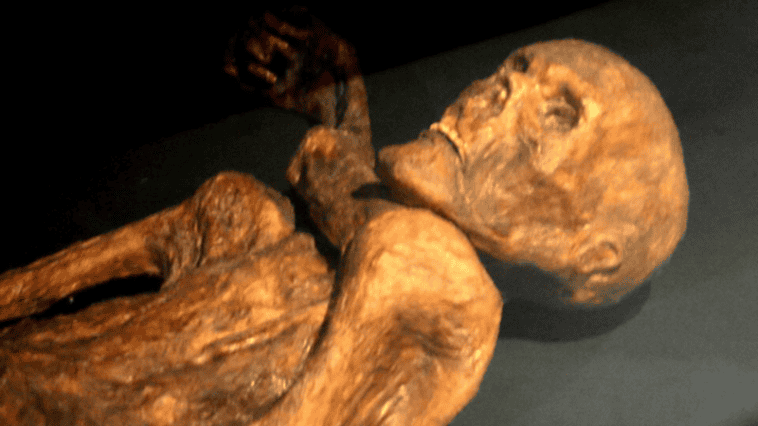
For decades, scientists have pored over the 5,300-year-old mummy known as Ötzi. Now, a new paper in the peer-reviewed journal Microbiome uncovered something unexpected: microorganisms are still present in his body, some of which may have accompanied him for millennia.
Found in 1991 by a tourist hiking the Alps, the Iceman’s remains date back to around 3300 B.C., centuries before Stonehenge, the pyramids, and most of what we think of as ancient civilization.
Ötzi stood roughly 5 feet 2 inches tall and was likely 45–46 years old at the time of his death, according to current bone analysis (earlier estimates had put him younger, between 25 and 35).
The arrowhead lodged in his left shoulder possibly severed a major artery, suggesting that he bled to death rather than froze, though the original theory had held for years. He also suffered a head injury and other wounds around the time of his death.
Not a relic, but a time capsule
Researchers at Eurac Research, based at the South Tyrol Museum of Archaeology in Bolzano, Italy, conducted the latest analysis. Using tissue samples, swabs, and advanced genetic sequencing, the team was able to tell apart the microorganisms that were present during the Iceman’s life from those that colonized his body after his death.
Among the findings were cold-adapted yeast species on his body that appear to have originated from the glacier itself and have stuck around ever since. His gut also contained bacteria that don’t show up in modern human intestines. This alone is an unusual discovery, as it gives researchers a valuable snapshot of microbial life in early human bodies before agriculture, cities, and most of what shaped modern biology.
“Ötzi therefore offers a rare glimpse into humanity’s microbial past,” Eurac Research said in a statement.
Some of these organisms may still be dormant rather than dead, a reminder that the mummy, housed in carefully controlled conditions at the South Tyrol Museum of Archaeology, is subject to close monitoring.
“Close microbiological monitoring ensures that the mummy suffers no damage,” explained Elisabeth Vallazza, director of the museum. “But further research and full conservation efforts are certainly needed to preserve it for many more generations,” she added.
How exactly these microbes survive in Ötzi’s frozen tissue still remains unclear. Conservation expert and co-author of the study, Marco Samadelli, noted that the survival conditions “are not yet fully understood. This study expands our knowledge in this area,” he added.
For Frank Maixner, director of the Institute for Mummy Studies at Eurac Research, the findings reveal the Iceman as a living ecosystem rather than a static artifact. “These yeasts have accompanied Ötzi on his long journey through the millennia,” he pointed out.
This latest insight underscores why Ötzi continues to be one of the most intensively studied human remains in modern science. Each new finding tends to rewrite our understanding of the past, and this one is no exception.
Sources: Eurac Research, Microbiome, Fox News