
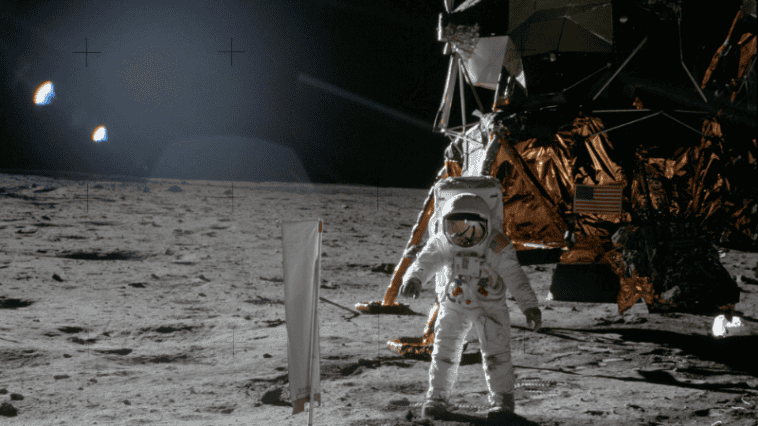
Two scientists want NASA to build a quarantine lab for alien germs on the Moon, rather than on Earth.
The pair, microbiologist and former Pentagon advisor Frederick Moxley and McGill University invasive species expert Anthony Ricciardi, argue that no terrestrial lab is secure enough to contain a truly dangerous extraterrestrial microbe.
The fear is old, predating NASA by almost two years, and centers on two core worries: humanity contaminating other worlds and our spacecraft bringing something deadly back to Earth. The second concern is far from a hypothetical one. It’s serious enough that the Apollo 11 crew was locked in quarantine for 21 days after splashdown.
“Humanity is entering a new era of space exploration, but our planetary protection strategies have not kept pace with the risks associated with returning extraterrestrial samples to Earth,” Moxley said in a statement. “The proposed facility would essentially act as a firewall between Earth and any potentially hazardous live organisms,” he added.
The call is coming from inside the ship
The twist is that the danger might not even come from alien life. The proposal also flags a more immediate, Earth-based threat: microbes that could evolve into tougher, drug-resistant versions during long space missions.
Back in 2018, a study identified a bacterium on the International Space Station (ISS), Enterobacter bugandensis, mutating into dangerous drug-resistant strains. Already nasty on Earth, it can cause septic shock in infants. Microgravity seems to have accelerated the problem by making it easier for bacteria to swap genetic material up there.
That’s why the real fear is closer to home. Crews returning from Mars, carrying “souped-up” versions of ordinary Earth bugs, is a real concern. Bacteria that used to be easy to kill could become far more resilient. The researchers acknowledge that this all sounds unlikely, but they counter that the odds are “largely unknowable,” which is why caution is warranted.
To address the uncertainty, the pair is calling for a new class of high-security laboratory, a notch above the CDC’s highest BSL-4 rating. The facility would operate without a human presence. Advanced robots would manage the handling, processing, and sterilization.
No material would leave the lunar facility or return to Earth until proven completely safe. The duo’s paper laying out the plan in detail ran in a recent issue of the peer-reviewed scientific journal Ambio.
“Decades of research on invasive species have demonstrated how an organism introduced to the wrong place at the wrong time can spread uncontrollably with potentially devastating and irreversible long-term impacts on ecosystems,” Ricciardi explained.
The authors’ closing argument practically writes itself: NASA once quarantined Apollo 11 astronauts Armstrong and Aldrin for three weeks after their return from the Moon. The agency can at least give this lunar biocontainment proposal a serious hearing.
Sources: McGill, Ambio, BMC Microbiology, Gizmodo