
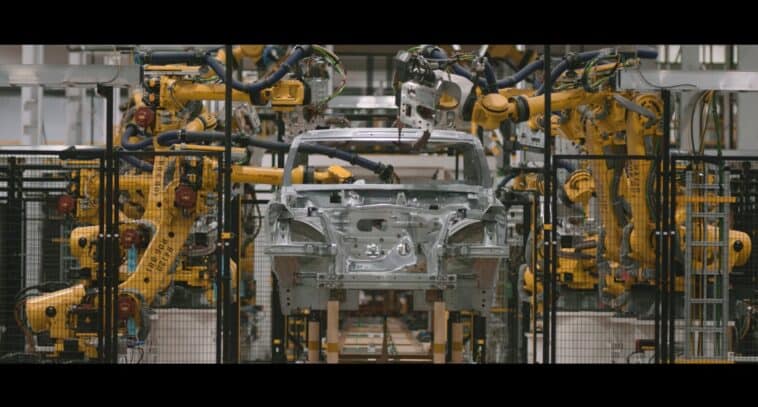
More than 1,000 workers at General Motors’ flagship Detroit assembly plant were idled, many of them indefinitely, as the company installed 50 robots. The United Auto Workers (UAW) union is calling the move exactly what it appears to be: automation is displacing people.
The robots in question, known as “cobots” (short for collaborative robots), have been installed on the assembly line at Factory Zero, the Detroit-Hamtramck EV plant where GM builds its electric trucks.
The changes come as the company’s EV production faces headwinds from slowing demand and cost pressures, even as GM continues broader electrification efforts alongside its ICE and hybrid lineup.
On the line and under the hood
At Factory Zero, the cobots are now bolting body panels onto vehicles as they move down the assembly line, working alongside the people who haven’t been laid off, as per AutoBlog.
GM, however, has been careful in its framing. The company insists the machines are not replacing workers but are instead helping the plant stay competitive while improving safety and ergonomics for the remaining workers.
“We’ve been installing cobots across our manufacturing footprint as part of a broader push to bring more advanced technology into our operations,” company spokesman Kevin Kelly explained to Crain’s Detroit Business. “At Factory ZERO, we are implementing them alongside our team, helping improve safety and ergonomics, while keeping our operations flexible and competitive,” he added.
The laid-off workers are only temporarily idled, according to the company, but GM has yet to provide a timeline for their return.
United Auto Workers Local 22 president James Cotton isn’t buying any of it. To him, the cobots are about one thing: taking away jobs from union members.
The 2028 collision course
“The bigger trend of declining labor needs in the auto industry isn’t subtle. The number of labor hours required to build a single car has dropped substantially since the 1980s due to automation and efficiency gains, per industry reports.
UAW wages, though, have continued to climb. The union secured historic gains in its 2023 contract and is expected to push hard for stronger job protections in its 2028 negotiations.
Cotton has another problem with the cobots, even beyond the layoffs. He doesn’t buy GM’s claim that the machines make things safer. Robots working right next to humans, he argues, raise their own safety questions. The union has already filed grievances against the company over them.
Add to it all, cobots showed up at a tough moment for GM’s EV business. Demand has been slowing, largely because of high costs, if the American Automobile Association (AAA) is anything to go by. The company has paused production at Factory Zero more than once over the past year as a result.
UAW President Shawn Fain framed the wider stakes in more forceful terms during his speech at the UAW’s quadrennial Constitutional Convention in Detroit in mid-June 2026: “The fruits of our labor have multiplied like never before, but workers aren’t reaping the harvest,” Fain said.
“And if AI continues to be used as an accessory to that crime, it has to be stopped. It doesn’t have to be this way. In a just society, when workers create more value, they see more of the benefit,” he added.
The numbers behind the layoffs make the union’s frustrations harder to swallow as the company posted $4.25 billion in profits for the first quarter of 2026, up 22 percent from the same period a year earlier, as per Yahoo Finance.
Sources: GM Authority, Crain’s Detroit Business, Automotive News, GM Investor Relations, The Detroit News, AutoBlog, NYP