
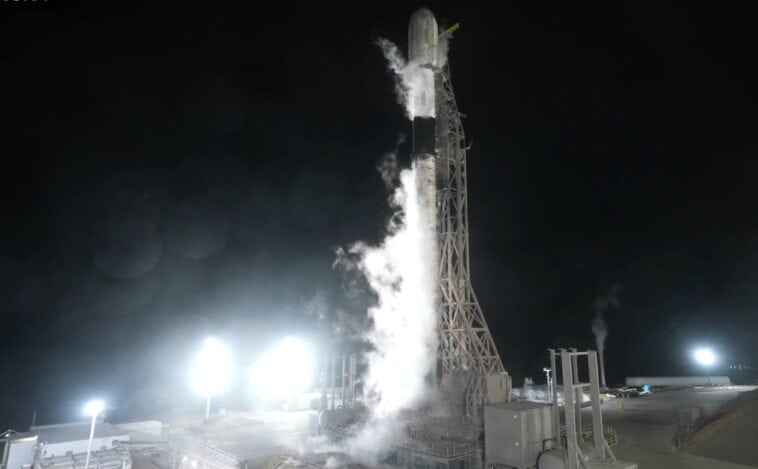
SpaceX put another batch of spy satellites into orbit early Friday morning (June 19), the third such launch for the Department of Defense’s (DOD) National Reconnaissance Office (NRO) this year.
The mission, designated NROL-179, lifted off from Vandenberg Space Force Base in California at 4:50 a.m. EDT aboard a Falcon 9 rocket carrying an undisclosed number of satellites into low Earth orbit as part of what the NRO calls a proliferated architecture constellation.
The payload is widely believed to be Starshield satellites, a government version of SpaceX’s Starlink, though neither the NRO nor SpaceX has confirmed that on the record.
Falcon 9’s first stage, called the booster B1103 on its third flight, returned to California soil at Landing Zone 4 less than eight minutes after liftoff. The booster, which previously flew the Starlink 17-35 and 17-42 missions in April and May, achieved the 35th landing at the site and SpaceX’s 626th booster recovery overall.
Inside the Pentagon’s expanding constellation
Friday’s mission was SpaceX’s 14th flight for the NRO’s low Earth orbit constellation, and the third this year. The agency has been vague about the exact scope of what it is building, but the broad strokes have emerged in pieces.
In its recent pre-launch statement, the NRO said that it plans to eventually put “hundreds of small satellites in orbit” to “provide greater revisit rates and increased coverage and eliminate single points of failure. This will ensure the analysts, warfighters, and civil agencies NRO serves receive actionable information faster than ever before,” the agency added.
How large the constellation will ultimately become remains under wraps, as do most of the mission specifics. The agency has, however, disclosed that its Geospatial Intelligence Systems Acquisitions Directorate (GEOINT) contributes hardware to the constellation, stating:
“GEOINT’s contribution to the NRO’s proliferated architecture includes electro-optical, radar, and relay satellites. Additionally, these relay satellites enable inter-satellite optical communications and serve as a key component of the NRO’s resilient communications architecture as well as the Department of War’s (DoW) upcoming Space-Data Network.”
Sources: National Reconnaissance Office, SpaceX, NRO Mission Page, Spaceflight Now