
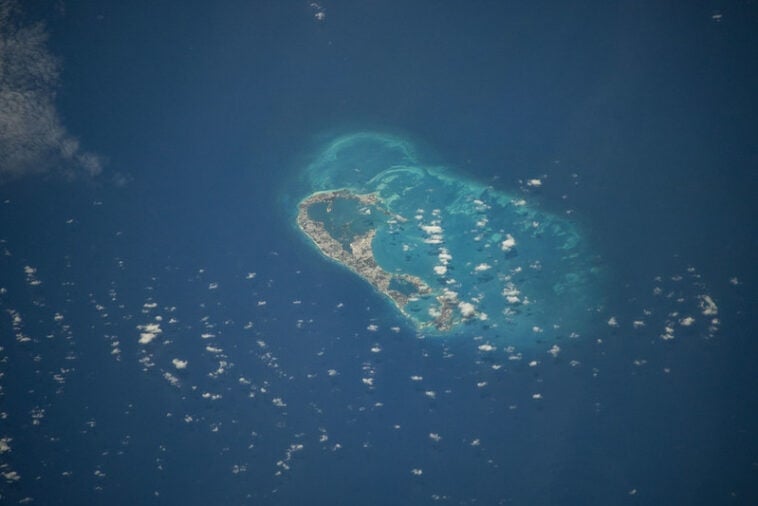
The Bermuda Triangle still gets brought up at dinner parties. We hear stories of vanishing planes, boats that disappeared without a trace, and compass needles going awry. Skeptics dismiss it all as nonsense, and documentary makers never seem to tire of the subject.
But buried under all the tabloid stuff is a question that has nothing to do with ghosts. It’s about Bermuda itself, the actual island. The place is high above the seafloor, so, geologically speaking, it already stands out as an anomaly.
There is no active volcano beneath the island, nor are any tectonic plates colliding in the area. By all the rules that geologists follow, this island should be sitting on the bottom of the sea, not rising prominently out of the Atlantic Ocean.
Scientists at the Carnegie Institution for Science (Earth and Planets Laboratory) and Yale say they’ve worked out what’s going on. The answer was sitting beneath the seabed the whole time.
Why Bermuda defies geology
The team identified a huge slab of rock, about 12 miles thick, lying beneath the seabed. This slab is lighter in weight than the material around it. It took shape millions of years ago when hot rock spread sideways below the crust, then cooled and solidified. Researchers compare its function to a buoyant raft, powerful enough to lift and hold Bermuda thousands of feet above the surrounding ocean floor.
William Frazer, a seismologist and the lead researcher on the study, told the Daily Mail that the geology in this region does not match how scientists typically explain such features. “Bermuda is an exciting place to study because a variety of its geologic features do not fit the model of a mantle plume, the classic way for deep material to be brought to the surface,” Frazer noted.
He elaborated his point to make the implications clearer: “This suggests that there are other convective processes within Earth’s mantle that have yet to be well understood.”
The thing worth pausing on is that last bit. Mantle plumes are the answer geology teachers give when explaining how deep planetary material winds up at the surface. Bermuda apparently didn’t form that way. Some other process did the work, and right now nobody can say exactly what that was.
The discovery is part of a wider pattern. Recent earth science findings keep poking holes in older models. Rock formations are showing up where they’re not supposed to be, and rock layers are behaving in ways that don’t match the textbooks. The interior of the planet, it seems, is more complicated than scientists have been assuming.
None of this makes the spookier Triangle theories any more believable.
Ship disappearances, weird instrument readings, and missing flights all have mundane, everyday explanations in most cases. Bad weather, ocean currents, pilot or captain mistakes, and the simple reality of statistics in one of the world’s busiest shipping and aviation corridors.
The island sitting where it sits, though, finally has an explanation grounded in measurable stuff. A 12-mile-thick slab of relatively light rock is acting as a raft for an entire patch of land.
Sources: AGU, Carnegie Science, My Charisma, National Ocean Service