
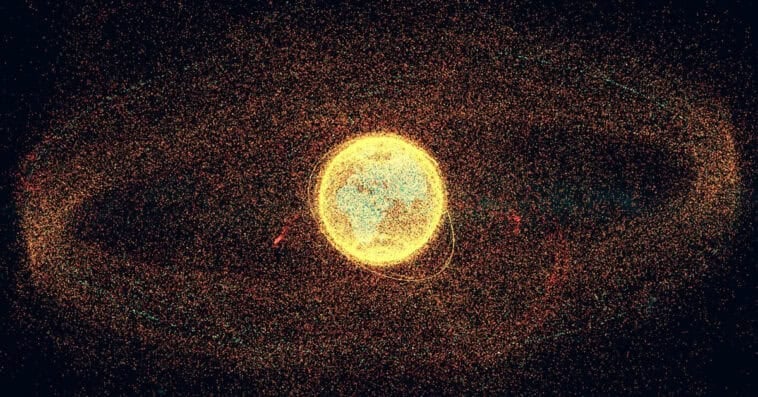
A few decades ago, Earth’s orbit was considered vast and empty, but today, it is rapidly becoming one of the most congested places humans have ever reached. New analysis suggests that nearly half of all tracked objects circling the planet are actually defunct satellites, rocket fragments, and other space junk, a figure driven upward by an unrelenting surge of satellite launches and failed missions. And as more hardware is sent skyward, scientists warn the problem is accelerating faster than it can be cleaned up, quietly turning low Earth orbit into a crowded, high-speed junkyard where even a tiny fragment could spell disaster for the technology we rely on every day.
Space junk is closing in on active satellites
Drawing on live tracking data from the U.S. Space Force via Space-Track.org, a recent analysis by the engineering firm Accu has mapped the true scale of Earth’s congested orbit. Currently, 33,269 distinct objects are being monitored as they whip around the planet. While roughly 17,682 of these are classified as satellites, the remainder of the census is comprised of orbital “ghosts”: discarded rocket stages, shrapnel from past collisions, and mysterious fragments that defy identification.
The study highlights a grim reality for future spaceflight: our active technology may soon outnumber our leftovers. According to the report, “this means that nearly 47 percent of tracked objects are space junk. However, with many satellites no longer operational, it means the true proportion of inactive or uncontrollable objects is even higher.”
This data suggests that the active portion of our orbit is a shrinking minority. As more satellites reach the end of their lifespans without a plan for removal, the line between a functioning tool and a dangerous projectile continues to blur.
The growing danger of Earth’s cosmic junkyard
Ever since Sputnik 1 ushered in the space age in 1957, we’ve been leaving a trail of litter in our wake. However, what was once a slow accumulation has turned into a high-speed crisis. Thanks to cheaper launch costs and a frantic schedule of missions, our orbital neighborhood is more crowded than ever; between 2020 and 2025 alone, the number of trackable objects surged by roughly 10,000.
Yet, the 33,000 objects we can see are likely just the tip of the iceberg. Engineering firm Accu warns that millions of microscopic hazards — like stray paint flecks or tiny metal shards — are swirling around us, completely invisible to our current tracking systems. In the vacuum of space, size doesn’t determine danger; speed does. Most of these fragments travel at speeds exceeding 17,000 miles per hour. At that velocity, even a speck of dust packs the punch of a speeding bullet.
There have already been close calls:
- 2024: Astronauts aboard the International Space Station were forced to take shelter after a defunct Russian satellite broke apart and scattered debris into orbit. That incident later helped trigger a U.S. government initiative focused on tracking the smallest fragments of orbital waste in low Earth orbit.
- 2025: Several Chinese taikonauts were temporarily stranded on the Tiangong space station after a suspected piece of space debris cracked the window of their return capsule.
While collisions pose a potential risk to astronaut safety, Accu’s analysis suggests the bigger threat is actually to satellites themselves. According to the data, there are about seven pieces of tracked space junk for every 10 satellites currently in orbit.
Who is responsible?
While space debris is a borderless problem that encircles the entire planet, its origins are surprisingly concentrated. According to the report, the vast majority of the “junk” clouding our skies can be traced back to just a handful of major spacefaring entities.
The analysis places the lion’s share of responsibility on a few key players:
- China: Estimated to be responsible for 65% of orbital debris.
- United States: Accounts for roughly 40% of the clutter.
- The Commonwealth of Independent States: This group, which includes Russia and eight other nations, contributes approximately 23%.
Global efforts to clean up space junk are underway
Recognizing that Earth’s orbit is reaching a breaking point, the world’s leading space agencies — including NASA, the Japan Aerospace Exploration Agency, the U.K. Space Agency, and the European Space Agency — are currently developing specialized missions to de-clutter the stars. The private sector is also jumping into the fray, with a new wave of orbital custodians pitching commercial services to hunt and remove drifting junk.
However, vacuuming the void is a monumental task that won’t happen overnight. Until these cleanup technologies become a daily reality, the focus must shift toward prevention and “debris-proof” engineering. The Accu report emphasizes that the burden now lies with those building the next generation of hardware.
“For the engineers shaping the spacecraft of tomorrow, they must keep space debris in mind from the start,” the report’s authors write. “Every component, from its precision, durability, and material, has to be chosen carefully to survive potential impacts. Space debris is a key challenge of the modern space age, but how it is tackled will drive innovation and define the future of space exploration.”
Sources: Accu, Scientific American