
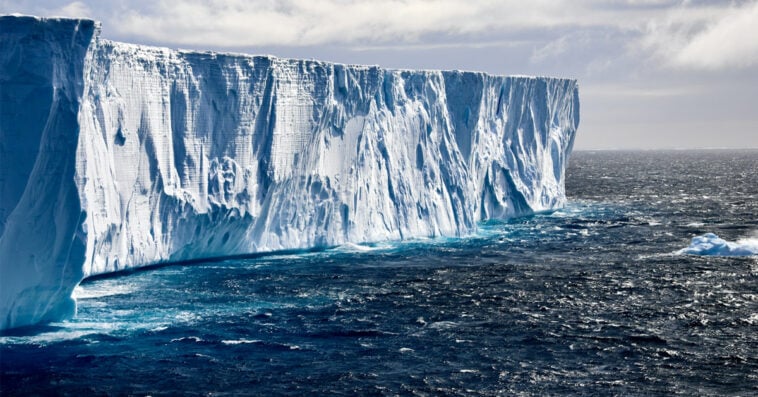
Antarctica’s frozen frontier is retreating, and the scale is far greater than many realize. Over the last several years, thousands of square miles of grounded ice have vanished from the continent’s outer edges, subtly redrawing the map of the southernmost continent. Scientists say this isn’t just a distant polar problem; it’s a shift that could ripple outward in ways that affect global sea levels and coastal communities worldwide. Keep reading to learn how researchers have measured this loss so precisely and what it signals about what’s coming next.
New satellite data reveals which parts of Antarctica are most at risk
A major new satellite study reveals that Antarctica has shed nearly 5,000 square miles —an area roughly twice the size of Delaware — of grounded ice in the past 30 years, as warmer ocean water eats away at some of the continent’s most fragile coastal zones.
The ‘line in the sand’ for sea levels
To understand the danger, you have to understand the grounding line. This is the invisible boundary where a massive glacier stops sitting on solid bedrock and starts floating on the ocean. Once ice crosses this line and begins to float, it’s already on its way to raising global sea levels.
Using a fleet of international satellites, researchers from the University of California, Irvine, tracked this boundary with surgical precision from 1992 to 2025. By monitoring how the ice moved with the tides, they could tell exactly where the ice was still “anchored” and where it had been lifted off the floor.
“We’ve known it’s critically important for 30 years, but this is the first time we’ve mapped it comprehensively across all of Antarctica over such a long time span,” said lead author Eric Rignot.
A tale of two Antarcticas
The study offers a bit of a “mixed bag” for our planet’s future. The data shows two very different stories playing out across the ice:
- The stable shield: About 77% of the coastline hasn’t budged since 1996. For much of the continent, the ice remains firmly locked in place.
- The vulnerable spots: In “hot zones” like West Antarctica and the Antarctic Peninsula, the retreat is aggressive. In some areas, the ice has pulled back by a staggering 26 miles.
The ‘punctured balloon’ effect
The culprit isn’t just warm air; it’s warm water. Deep underwater “valleys” act like highways, funneling heat directly to the base of the glaciers. This melts the ice from the bottom up, thinning the shelves until they can no longer hold back the massive glaciers behind them.
Rignot describes the current state of the continent with a vivid metaphor: “It’s like the balloon that’s not punctured everywhere, but where it is punctured, it’s punctured deep.”
While the majority of Antarctica is holding the line, the areas that are failing are doing so in spectacular, high-stakes fashion.
A troubling pattern scientists can’t explain yet
While much of the Antarctic retreat can be blamed on warming oceans, one specific region is currently defying scientific logic. Researchers have hit a wall when looking at the Northeast Antarctic Peninsula, where the ice is vanishing, but the “usual suspect”—warm water—is nowhere to be found.
In this corner of the continent, the ice hasn’t just retreated; entire ice shelves collapsed before this study even began. Since then, the glaciers behind them have been pulling back at an alarming rate. Usually, scientists look for deep-water “highways” bringing heat to the ice’s edge, but here, the data doesn’t provide a clear smoking gun. “Something else is acting — it’s still a question mark,” said Rignot.
Whether it’s shifting atmospheric winds, hidden internal stresses in the ice, or a factor we haven’t yet discovered, this region proves that Antarctica still holds secrets that could change how we predict future sea-level rise.
Reality check for climate models
The researchers say the study does more than document past ice loss — it offers a powerful way to test how well scientists can predict the future. Climate models are used to estimate how much sea levels could rise in the coming decades, but those projections are only as reliable as the data behind them. By creating a detailed 30-year record of how Antarctica’s grounding line has shifted, the team has produced a real-world benchmark that computer simulations must now match.
“Models have to demonstrate they can match this 30-year record to claim credibility for their projections,” Rignot explained. “That’s the real value of this observational record: knowing that this grounding line migration has happened.”
Antarctica’s calm may be temporary
Although large portions of Antarctica appear stable for now, Rignot warns that this balance may not last forever.
“The flip side is that we should perhaps feel fortunate that all of Antarctica isn’t reacting right now, because we would be in far more trouble,” he said. “But that could be the next step.”
Source: Space.com, Proceedings of the National Academy of Science