
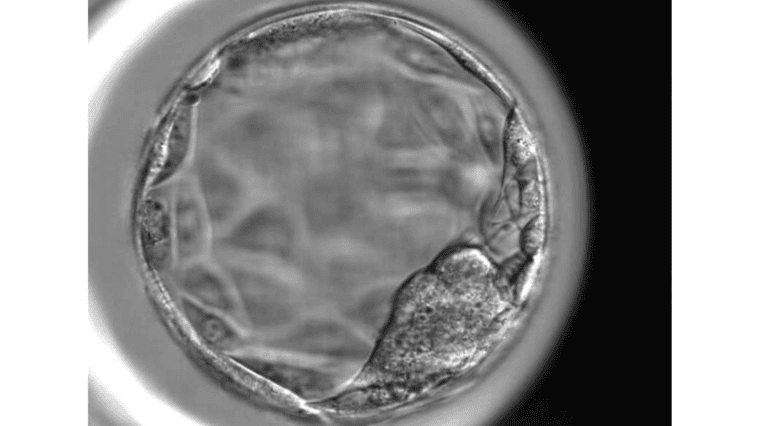
China sent synthetic human embryos to its space station this month, the first experiment of its kind. The goal is to determine whether one of the earliest stages of human development can withstand microgravity.
The samples aren’t real embryos, however. They’re stem cell-derived embryo models and look a lot like the real thing, but they cannot grow into a fetus.
“This is not a real human embryo and does not have the ability to develop into an individual. However, it can serve as a model for studying early human development,” said project leader Yu Leqian, a researcher at the Chinese Academy of Sciences’ Institute of Zoology, in an official CAS statement.
The bigger question underneath all this is whether humans could ever reproduce off Earth. Without that ability, long-term Mars settlements, lunar outposts, or crewed generation ships would all ultimately fail if our biology cannot support reproduction in space.
So, before anyone gets to the science-fiction stuff, we must first overcome the fundamental challenge, the human body.
Why space is rough on embryos
Space treats the human body badly, even inside a spacecraft. Microgravity is one problem, sure, but it is compounded by intense radiation and cosmic rays, the kind of thing that Earth’s atmosphere normally shields us from down here.
Animal studies so far have offered encouraging results, though. Back in 2016, Chinese scientists successfully grew mouse embryos in space and got them to the blastocyst stage, the point at which an embryo is ready to implant in the uterus.
Japanese researchers pulled off the same milestone in 2023, though their microgravity embryos had roughly a 24 percent chance of reaching that stage, which is about half the success rate observed on Earth.
Mouse embryos and human ones are not the same challenge, though, and these new samples being synthetic is a reminder of how slow and careful the progress is.
How the experiment is set up
The embryos were launched into the Tiangong space station aboard the Tianzhou-10 resupply mission on May 11 and placed into an experimental module. The experiment involves two sample groups, each representing a different stage of early development.
One set was cultured on uterine cells to simulate implantation, and the other was suspended in a microfluidic chip to mimic the period (roughly 14 to 21 days after fertilization) when cells begin organizing into tissues and organs.
“The experiment is going very well,” Yu said. “A pre-set automated system changes the culture medium for the samples every day,” he added.
The plan was for the experiment to run five days before the embryos are frozen. The results will remain unknown until the samples return to Earth and are compared against a control group that remained on the ground.
If it doesn’t work
A bad result wouldn’t derail the idea of human reproduction in space. The 2023 Japanese study, for instance, found that embryos in an artificial gravity setup had about a 5 percent better shot at blastocyst development than the microgravity ones, suggesting that there may be other practical workarounds.
“[We might] use certain technologies to mitigate the impact,” Yu told the South China Morning Post. “This is our first attempt to answer [the questions]: Can humans survive and reproduce in space? I hope the answer is yes,” Yu concluded.
Sources: CAS, South China Morning Post, Futurism, iScience