
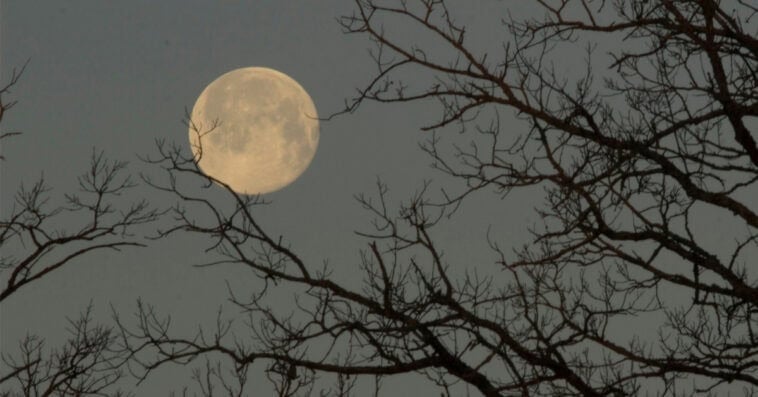
A rare lunar double feature is set to light up the night sky this weekend, and it won’t be back for years. A blue micromoon — when the month’s second full moon coincides with the moon being at its farthest point from Earth — will briefly rise, appearing slightly smaller and dimmer than usual before quickly slipping out of view. It’s not a dramatic spectacle like a lunar eclipse, but its rarity makes it worth catching, especially since skywatchers won’t see another one like it until 2028. Here’s exactly when and how to spot the elusive blue micromoon before it fades from sight.
The mystery of the ‘blue’ label
Contrary to what the name might suggest, the moon will not take on a sapphire or turquoise hue. In modern astronomy, a “Blue Moon” is simply a seasonal or monthly marker. This weekend’s event follows the “monthly” definition: it is the second full moon to occur within a single calendar month, following the first full moon on May 1. According to EarthSky, these occurrences happen roughly every two to three years. After this weekend, the next opportunity to witness a Blue Moon won’t arrive until December 31, 2028.
Why is it called a ‘micromoon’?
While most people are familiar with the “supermoon” — when the moon looks exceptionally large because it is at its closest point to Earth (perigee)—this weekend offers the exact opposite. Because the moon’s orbit is elliptical rather than a perfect circle, it occasionally reaches a point called “apogee,” its farthest distance from our planet.
During this event, the moon will be approximately 252,360 miles away. For comparison, a typical Supermoon can be as close as 225,130 miles. This extra distance means the moon will appear roughly 6% smaller and 10% dimmer than your average full moon.
What to look for
The moon won’t be traveling alone. Viewers in the Northern Hemisphere will see it positioned near Antares, a brilliant red supergiant star located 550 light-years away. Known as the “Heart of the Scorpion” in the constellation Scorpius, Antares provides a sharp, fiery contrast to the moon’s pale glow.
In certain parts of the world, this pairing becomes even more dramatic:
- The southern hemisphere experience: For observers in New Zealand, eastern Australia, Chile, Argentina, and parts of Antarctica, the moon will actually pass directly in front of Antares. This “occultation” will cause the star to temporarily vanish from view.
- The rest of the world: While the star won’t disappear for those in the North, Antares will remain a constant, bright companion visible right next to the lunar disk throughout the night.
Viewing tips and live streams
If you want to witness this event, you may need to be a bit more observant than usual. Gianluca Masi of the Virtual Telescope Project told the Associated Press that the micromoon’s decreased brightness and size “are subtle enough to likely go unnoticed by most observers” unless they are intentionally looking for the difference.
To ensure you don’t miss it:
- Find dark skies: Because the micromoon is 10% dimmer, moving away from city light pollution will help you appreciate its glow and see the neighboring star, Antares, more clearly.
- Watch online: If weather conditions are poor or you are outside the viewing zone for the Antares occultation, the Virtual Telescope Project will be hosting a live stream featuring high-definition images captured by their robotic telescopes.
Sources: EarthSky, Virtual Telescope Project, CBS News