
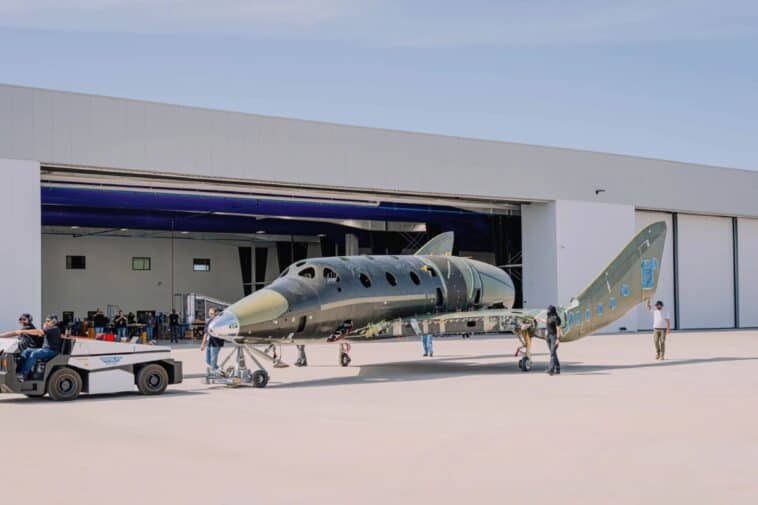
After a nearly two-year pause, Virgin Galactic says it’s on track to fly paying customers again before the end of this year.
The company laid out its progress on its recent Q1 2026 earnings call, noting that work on its first next-generation suborbital spaceplane, the Delta-class spaceship, is moving forward on the schedule it gave investors on its Q4 2025 earnings call in March.
The first SpaceShip’s airframe just moved from the assembly hangar over to a test and launch hangar at the company’s production site near Phoenix. The plan from here is to finish assembling the vehicle by the Q2 2026 earnings call in August. After that, Virgin Galactic’s carrier aircraft, VMS Eve, will transport it to Spaceport America in New Mexico for testing.
“We remain on track to commence flight testing in Q3 and space flight in Q4,” CEO Michael Colglazier said on the call.
The Customer backlog
Virgin Galactic has roughly 650 existing ticket holders (customers who purchased seats before the company paused commercial flights). The company has begun informing them of their approximate flight windows, which are scheduled to begin in January 2027 and continue through the first half of 2028.
CFO Doug Ahrens laid out the planned flight cadence, which calls for four flights per month starting in January 2027 and ramping up to eight per month in the second quarter, once a second SpaceShip, now under construction and due late this year or early next, enters service.
The company has a track record of missing previous deadlines, so whether it can execute on this accelerated cadence remains to be seen.
Tickets and Pricing
In the Q4 2025 earnings call, the company announced it would sell 50 tickets at $750,000 each as a way to restart commercial sales. This week, however, executives wouldn’t say how many of those had sold, but they described demand as strong.
“The response has been strong and global in nature, and we’ve received qualified inquiries from customers across more than 20 countries,” Colglazier said. Interest is coming from individuals, research groups, and government agencies, he noted.
He added that the company has “secured deposits for a meaningful portion of the available seats at this price point” and expects to close out this round during the Q3 glide flight program. After that, Virgin Galactic will pause ticket sales to onboard the new customers. When sales reopen, prices are expected to go up.
Higher flight rates than were possible during the Unity era with the retired VSS Unity vehicle will require significantly more rocket motors. To achieve this, the hybrid motors that power SpaceShip will get their own assembly line at the Phoenix facility, with construction of the line due to wrap up in Q4.
Once the vehicles are completed, assembly workers will shift to motor production to keep the program on track.
The Money Side
Despite ongoing development costs, Virgin Galactic’s financial position remains solid heading into its return to flight. The company posted a $65 million net loss in the first quarter and negative free cash flow of $93 million, but ended the period with $251 million in cash on hand.
Executives believe this balance is enough runway to reach commercial service, especially as costs will come down once the vehicles are finished. The company also raised $52 million in April through an at-the-market stock sale and has the capacity to pull in another $87 million via the same facility.
The Unity vehicle has been grounded for a while now. Whether this new ship and the production setup behind it can deliver on the timeline being promised is the open question.
Sources: Virgin Galactic, Space News, SPCE Q4 2025