
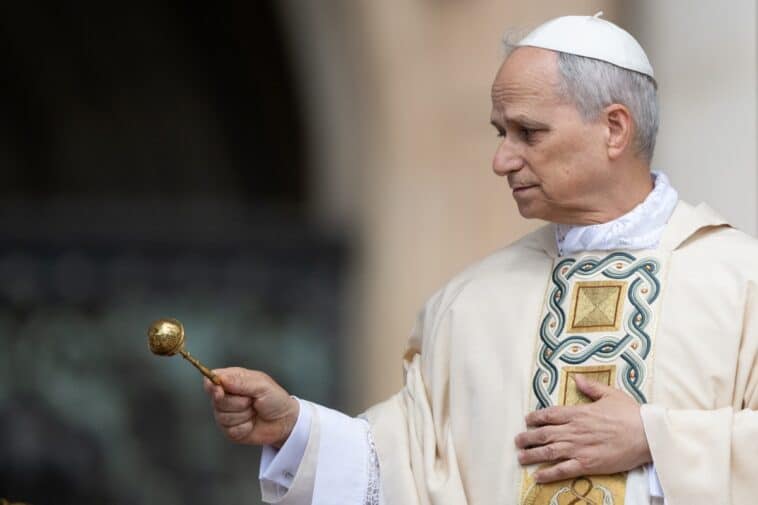
Pope Leo XIV has issued the first major teaching document of his papacy, and the central message is safe to say, quite blunt. Artificial intelligence, he noted, needs to be “disarmed.”
“The word is strong, I know, but deliberately chosen because this moment needs words capable of attracting attention,” he added.
The document is what the Vatican calls an encyclical. Technically, they’re meant to be letters to Catholic bishops of the universal Church, but over the past several decades, they’ve turned into a pope’s way of addressing the whole world. Every encyclical has its own distinct Latin title, and this one is called Magnifica Humanitas, which translates to ‘Magnificent Humanity.’
Most of the document centers around AI, but Pope Leo also folded in one of the strongest apologies the Vatican has ever made for the Church’s role in slavery. He wrote that it was “impossible not to feel deep sorrow when contemplating the immense suffering and humiliation endured by so many” and that he “sincerely asked for pardon” on the Church’s behalf.
The encyclical joins these seemingly distant topics. The Pope tied the slave trade directly to AI, arguing that the world is at risk of normalizing the exploitation of people all over again, both in how the technology gets built and in how it gets used. Some of his sharpest language drew a line between historical slavery and what he called “new digital slaveries.” He even raised the idea of “digital colonialism,” linking old colonial abuses to current tech practices.
A Vatican event with AI executives in the room
The Pope chose to present the encyclical himself at the Vatican recently. An unusual step, as popes normally leave such public launches to senior Vatican officials. Standing alongside him were AI experts, including Christopher Olah, a co-founder of the American AI company Anthropic.
Olah, who spoke at the event, didn’t sugarcoat the precarious position the industry is in. Every AI lab, his own included, operates “inside a set of incentives and constraints that can sometimes conflict with doing the right thing,” he said.
He also pushed back on the notion that AI should be left to the technologists. “The questions raised by AI are bigger than the AI research community, not just in their implications, but also in their nature,” Olah observed.
A message aimed at the powerful
A lot of the document reads as a direct warning to people in positions of power about reining in the threats posed by artificial intelligence.
Pope Leo came down hard on the use of AI in warfare. Pushing humans further out of decision-making on lethal weapons, he argued, makes it even harder to ever call a war “just,” and he warned against kicking off an AI arms race.
“No algorithm can make war morally acceptable,” he wrote.
AI doesn’t strip away the “intrinsic inhumanity” of war, in his view. It risks making things worse by sparking conflict faster and making it more impersonal, “lowering the threshold for resorting to violence, transforming defense into threat prediction and thus reducing victims to data.”
He also went after AI’s effect on politics, pointing to manipulated images and videos that feed people biased or misleading versions of reality.
Then came a line aimed squarely at the people building these systems. “Developers bear a particular ethical and spiritual responsibility, for every design choice reflects a vision of humanity,” he noted.
Whether any of it lands is another matter
The Pope has set up a commission to carry forward the encyclical’s recommendations. How much it’ll accomplish against the speed of the technology is a real question.
However, there’s a recent precedent worth keeping in mind. Back in 2015, the late Pope Francis wrote Laudato Si, his encyclical on the climate crisis. By 2023, he was following it up to express his disappointment at how little had actually been done. For all his urgency on AI, Pope Leo could find himself in a similar spot down the road.
Sources: Vatican.va, Anthropic, BBC, Vatican News