
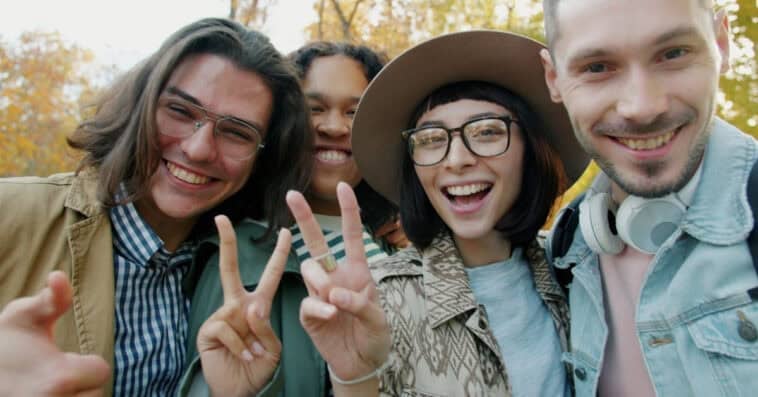
That casual “peace sign” you flashed in your last vacation photo might have just handed a stranger the keys to your digital life. While we’ve long been warned about oversharing our locations or personal details, a new frontier of AI-driven biometric theft means that simply showing your palms to a high-resolution camera could allow hackers to recreate your unique fingerprints from several feet away. As smartphone lenses become sharper and AI tools gain the power to enhance even the smallest ridges on your skin, your go-to selfie pose is transforming from a harmless gesture into a security nightmare. Read on to discover how deep this vulnerability goes and why experts say it’s time to rethink how you wave at the camera before your biological identity is compromised for good.
The five-foot danger zone
Recent reports circulating in China have reignited fears over how easily our physical identity can be harvested from social media. Experts suggest that any photo where your fingertips are facing the camera from within a distance of five feet could provide enough detail for a bad actor to recreate your fingerprint.
Once a fingerprint is digitally reconstructed, it can theoretically be used to “spoof” or trick biometric scanners on smartphones, laptops, and even secure payment systems.
How AI sharpens the threat
In the past, a blurry photo was a natural defense against this kind of theft. However, the rise of artificial intelligence has changed the game. Financial expert Li Chang warns that “photo editing software and AI tools can sharpen fingerprint ridges hidden in everyday selfies.”
While environmental factors still play a role, the margin for error is shrinking. Jing Jiwu, a professor at the University of Chinese Academy of Sciences, notes that while lighting, motion blur, and focus still complicate the process, “high-resolution images or multiple photos can significantly improve the odds of extracting usable fingerprint data.”
A decade-old concept meets modern tech
The idea of stealing a fingerprint from a photo isn’t entirely new, but the technology to do it has moved from the laboratory to the smartphone.
As far back as 2013, German biometrics researcher Jan Krissler bypassed Apple’s Touch ID shortly after its release. A year later, he famously recreated the fingerprints of Germany’s defense minister using nothing but standard press photographs of her hands.
What was once a highly technical and impractical feat is now becoming alarmingly simple. In 2021, researchers at Kraken Security Labs proved that a working “spoof” fingerprint could be created using just a photograph, Photoshop, a laser printer, and some wood glue.
Why do we still use fingerprints?
If the risks are so high, why do tech giants like Apple, Google, and Samsung continue to rely on fingerprint scanners? The answer is simple: convenience.
Biometrics offer a “frictionless” experience, allowing users to unlock phones and authorize payments in a fraction of a second. While they may not be as unhackable as a complex, unique password, they still provide a high level of protection against casual theft and unauthorized physical access.
How to protect yourself
You don’t have to stop taking selfies, but a little awareness goes a long way. To keep your biometric data safe, experts suggest:
- Mind the distance: Be cautious of close-up shots where your fingertips are clearly visible and in focus.
- Flip the hand: If you love the peace sign, try facing your palm toward yourself rather than the camera.
- Use multi-factor authentication (MFA): Don’t rely solely on your fingerprint; use a secondary code or app to secure your most sensitive accounts.
Source: Techspot