
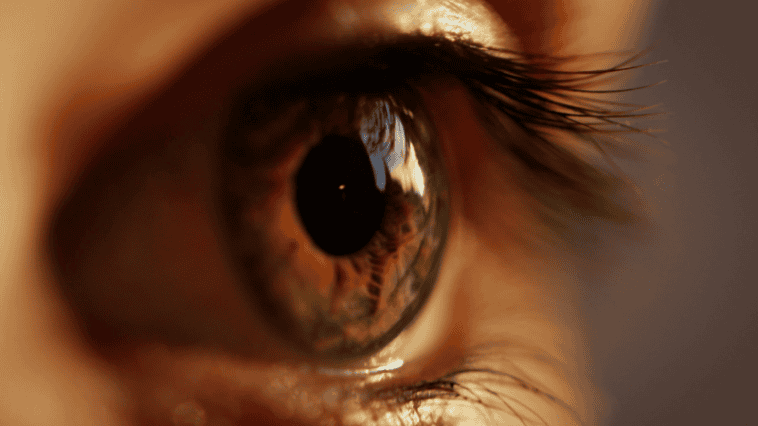
Thanks to a chip that sits at the back of the eye, some people who lost their sight to a common eye disease are reading again. The system is called PRIMA, and it’s already made a difference for dozens of patients across European trials.
PRIMA treats age-related macular degeneration, a condition that ranks among the top causes of vision loss in older people, with roughly a million Americans living with it.
The device itself is a tiny, square disc measuring 2 millimeters on each side and embedded with around 370 light-sensitive pixels that a surgeon places behind the retina. Daniel Palanker, a Stanford professor who is both an ophthalmologist and an electrical engineer, developed the device.
The implant, however, is only half the system. Patients must also wear a set of augmented-reality glasses with a built-in camera that captures what they’re looking at and beams the information to the chip as near-infrared light.
Because the pixels run on light rather than a battery or wires, they translate it into small electrical pulses that stimulate the retinal cells that survived the disease, effectively carrying signals to the brain much like natural vision.
Putting the pixels to the test
The results from the trial seem promising so far. Published in the New England Journal of Medicine, the study found that among 32 participants, 26 saw meaningful improvement a year after getting the implant. Patients gained five lines on an eye chart, with one even improving by 12.
Some patients who could barely make out the largest letter on a chart are now managing large print and getting through daily tasks on their own.
Science Corp., the Alameda-based company turning this into a product, is targeting a European regulatory green light this summer. Clearance from the FDA is going to take longer, though Science Corp. is trying to shortcut some of that through a humanitarian device exemption.
Palanker spent years developing lasers for cataract procedures before turning his attention to vision restoration.
He credits the leap to relying on light for both power and activation and doing away with wires entirely: “Until now, people tried restoring sight and all they got were light and shapes,” Palanker noted in a statement to the San Francisco Chronicle. “We succeeded, I think, because we properly encode information and the brain understands this information as vision,” he added.
Palanker’s team has already begun adapting the device to handle other causes of blindness, including Stargardt disease (a genetic form of macular degeneration that typically strikes younger people and causes progressive central vision loss), and aims to make the next generation implant capable of resolving images up to five times more sharply.
“It’s huge,” Jason Menzo, who runs the Foundation Fighting Blindness, told the SF Chronicle. “The field has never ever been anywhere near as advanced as it is today. Just knowing there’s something out there, just the promise of the technology, whether an individual even gets the device, is lifting people’s spirits,” he added.
Sources: NEJM, Yahoo Finance, Stanford, NYP, San Francisco Chronicle, CDC