
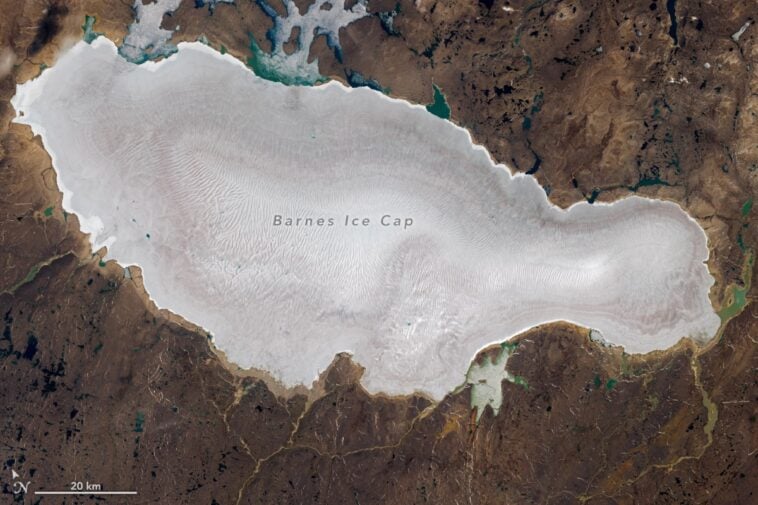
Climate change may have stopped the start of a new glacial period, according to a study of a shrinking ice cap in northern Canada, though scientists say that’s not good news.
The research, published in the journal Science, analyzed the Barnes Ice Cap on Baffin Island in the Canadian Arctic territory of Nunavut.
The ice cap is about the size of Delaware and is all that’s left of the ancient Laurentide Ice Sheet, a colossal continental glacier that, around 20,000 years ago, blanketed North America, covering land from the Arctic down to Illinois.
Specifically, the study found the ice cap was at its smallest about 3,000 years ago. And about 2,000 years ago, it started growing again, which the authors say marked the beginning of a new glacial period.
Then, around 1960, the ice cap began to shrink as human emissions drove up summer temperatures.
“It was just getting started, everything was normal, the next glaciation was about to happen — and yet it stopped,” said Nicolás Young, the study’s lead author and a geochemist at Columbia University’s Lamont-Doherty Earth Observatory, in a statement.
How researchers uncovered the timeline
To track when the ice cap began to re-expand, marking the start of the new ice age, the team dated old mosses found near its edge. The ice cap doesn’t slide over the ground, so the plants it covered were kept in place. They also tested nearby rocks to see how long they had been free of ice.
Study co-author Gifford Miller called the reversal “an illustration of the real power of greenhouse gases,” in a statement.
While researchers note it would have taken thousands of years for any encroaching ice to noticeably impact human civilization, the findings illustrate the scale of humanity’s influence on the climate.
“What has been an extremely natural and predictable phenomenon is now gone,” Young noted.
Sources: Science, Columbia Climate School, University of Colorado Boulder, CNN