
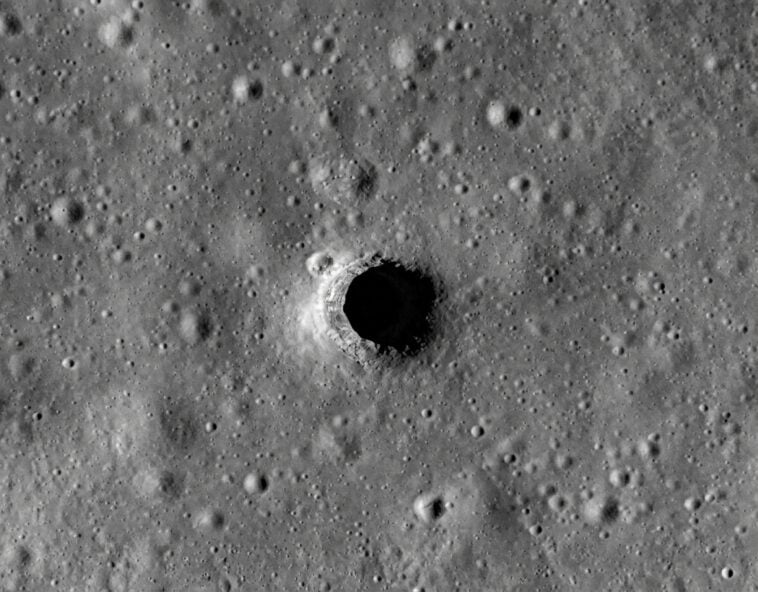
NASA is sending a rover to investigate a hole on the Moon. The target is a pit in the Marius Hills region on the Moon’s near side, an area with a history of volcanic activity. NASA suspects the hole could be an opening into an underground lava tube. Here is all we know about the development.
NASA thinks the Moon may have underground tunnels
The Marius Hills region is packed with ancient volcanic features, including long channels called sinuous rilles. Scientists once thought these were created by water flowing across the Moon. We now know they can form from flowing lava, including lava that moved through underground tubes. The Marius Hills pit sits in the middle of one of these rilles, which makes its origin particularly interesting.
NASA believes the pit may be where the roof of an ancient lava tube collapsed. An impact could also have punched through the roof, creating the opening we’re now interested in exploring.
What if the hole leads to a giant lunar cave?
Underground lava tubes could potentially provide natural shelter for future astronauts living on the Moon. The lunar surface is exposed to intense radiation, extreme temperature swings and micrometeoroid impacts.
According to NASA, confirming these underground spaces could help future habitat planning because the tubes could provide thermal stability and protection from radiation and micrometeoroids.
NASA is bringing serious gear
NASA has selected the Geophysical Instruments for Marius Lunar pit Investigation (GIMLI) project to investigate what is happening beneath the surface. The mission will use several instruments to basically give the Moon a geological scan. The instruments include a ground-penetrating radar to look beneath the surface, seismic sensors to detect vibrations and map underground structures, cameras to photograph the pit and its walls and a gravimeter to measure tiny variations in gravity that can reveal what’s hiding underground.
The Planetary Science Institute is leading the project, with Honeybee Robotics, a Blue Origin company, helping develop the equipment for a commercial lunar lander and rover.
Even if there is no cave, NASA still wins
The best part of planetary science is that not finding what was expected doesn’t equal failure. If GIMLI confirms a lava tube, scientists can map its dimensions and learn how ancient volcanism shaped the Moon billions of years ago.
If there isn’t a hidden tube underneath, the readings will still help scientists determine how the pit formed and expand our understanding of the Moon’s volcanic evolution. Either way, it’s a win for space exploration.
Sources: IFL Science, Daily Galaxy