
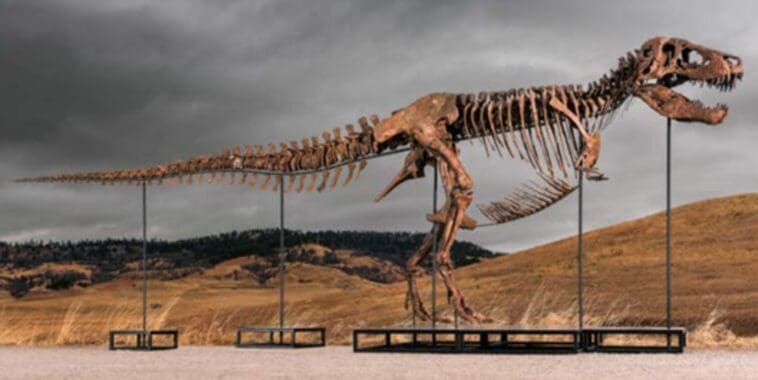
One of the largest and most complete T. rex skeletons ever found was recently sold at Sotheby’s for more than $50 million, setting a new record for a dinosaur fossil. The private buyer has left paleontologists upset and, more importantly, concerned about the specimen’s future accessibility.
Nicknamed Gus, the fossil spent 67 million years buried in South Dakota’s Hell Creek Formation before a private company excavated it in 2021.
The already mounted skeleton is about 61% complete, stands 12.5 feet tall at the hips, and features an exceptionally well-preserved skull with the bones bearing bite marks from another prehistoric animal. Estimated to sell for $20 to $30 million pre-auction, Sotheby’s called it “one of the largest and most complete T. rexes ever discovered.”
Essentially, it’s the kind of specimen most natural history museums would build an entire exhibit around.
The battle for public access
The Society of Vertebrate Paleontology (SVP) released a statement after the sale, declaring that fossils of this importance “represent far more than rare collectibles.” The group’s longstanding position is that scientifically significant specimens should be housed in accredited museums, universities, or other public research institutions where they remain available for study.
The primary concern is about what happens to the fossil years or even decades down the line, as many of the biggest advances in paleontology come long after a fossil is collected.
Techniques such as high-resolution CT imaging, geochemical analysis, and molecular research continue to produce new findings from specimens dug up more than a century ago, largely because those fossils remained in public collections.
“When these fossils enter private ownership without provisions for long-term access, opportunities for future research, education, and public engagement may be permanently diminished,” the society noted.
In comments reported by The Guardian, Richard Butler, a vertebrate paleontologist at the University of Birmingham, described the sale as “very concerning” and said fossils that don’t end up in recognized museum collections are effectively “lost to research.” Stephen Brusatte of the University of Edinburgh added that there’s “little that scientists, museums or universities” can do when specimens reach these price levels.
Sotheby’s, however, defended the private excavation of Gus, arguing that without commercial fossil hunters some dinosaurs would never be recovered at all. The price, according to the auction house, reflects both the significance of the remains and the effort required to bring them out of the ground.
Sources: Sotheby’s, Society of Vertebrate Paleontology, The Guardian, Daily Mail