
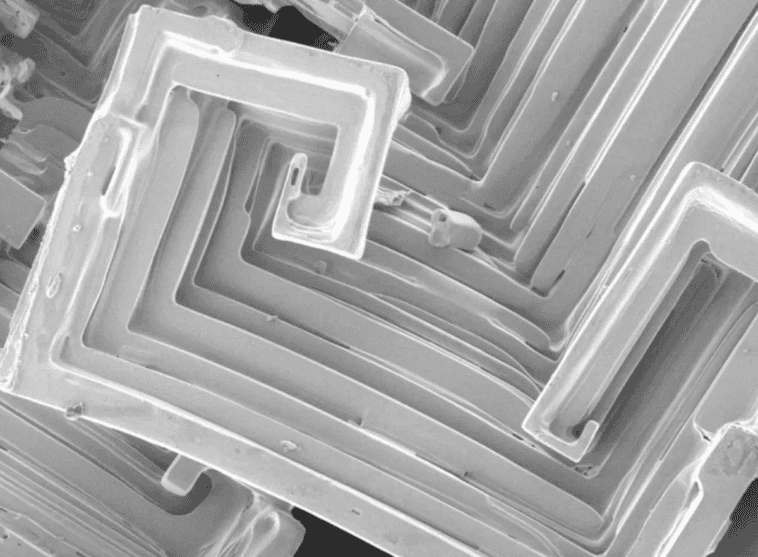
NASA has shared a stunning microscopic photo of a potassium chloride crystal grown aboard the International Space Station (ISS), and it looks less like ordinary salt and more like a tiny sci-fi skyscraper twisting into itself. If someone told you the image was generated by Midjourney or some AI image generator, you would probably believe them.
But the bizarre shape is not the result of fancy editing or alien chemistry. That’s just what happens when gravity steps out of the picture.
Space fired gravity and nature basically started showing off
The image, captured by NASA astronaut Don Pettit, shows a common crystal behaving in a way that is nearly impossible to recreate on Earth.
Potassium chloride is nothing exotic. It’s a salt commonly used as a sodium substitute in foods and sports drinks. Here on Earth, it typically forms neat little cubes. But orbit changes everything, as explained by Anne Wilson, a professor of chemistry and biochemistry at Butler University.
The ISS exists in microgravity, a near-weightless environment where gravity’s effects are dramatically reduced. Gravity is not completely gone, but it’s so weak that other forces, like molecular attraction and polarity, suddenly become the main characters.
Think of it like muting the loudest instrument in a band. You start hearing all the subtle sounds that were buried underneath.
The crystal literally grows differently
On Earth, crystals eventually become heavy enough to sink, bend, or break as they grow. But in microgravity, they just keep going. Instead of growing evenly across their flat surfaces, these potassium chloride crystals expand mostly from their edges and corners. The middle stays hollow while the outer edges continue building outward, creating geometric, stair-stepped pyramids that almost look handcrafted.
Scientists call this phenomenon hopper growth. As new corners form, the crystal can even change direction during growth, creating the elegant curling pattern seen in NASA’s image.
Not just space eye candy
Sure, the crystal looks like it belongs in a futuristic art gallery. But researchers are interested in it for a much less Instagram-worthy reason.
When materials grow without gravity constantly pulling on them, they often develop with far fewer imperfections. That gives scientists a rare glimpse of what an almost “perfect” crystal structure looks like.
Understanding those ideal structures could eventually improve manufacturing for things like semiconductors and other high-performance materials. Perhaps the path to better computer chips starts with watching salt grow in orbit.
Source: Live Science