
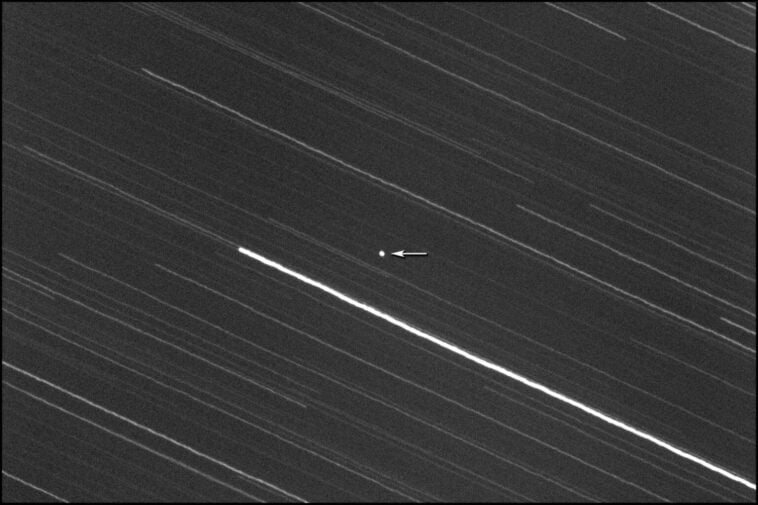
A small asteroid flew past Earth on Monday. It came closer than the moon, but NASA confirmed that there was no chance of impact.
At its closest point, the rock called the 2026 JH2 passed about 56,000 miles from Earth. For comparison, the moon is roughly 239,000 miles away.
Astronomers caught sight of the object just days before the flyby, with five observatories providing tracking data, including Farpoint Observatory in Wabaunsee County, Kansas, and Mount Lemmon Observatory in Arizona’s Santa Catalina Mountains.
NASA’s Jet Propulsion Laboratory (JPL) estimated that the asteroid is between 50 and 115 feet across. This size, roughly comparable to a school bus, was calculated based on how bright it appeared and how much light its surface likely reflects.
Because the object was only recently discovered, these size estimates may be refined as more data becomes available.
So far, astronomers have only made 24 observations of the rock. Its orbit was still being refined at the time, but orbital projections from NASA/JPL allowed experts to rule out any collision risk early.
2026 JH2 belongs to the Apollo group of near-Earth objects. NASA describes the group this way: “These asteroids have an orbit that is larger than Earth’s orbit around the Sun and their path crosses Earth’s orbit.”
Asteroids of this size pass near Earth several times a year. Most go unnoticed because they’re small and relatively faint.
The Virtual Telescope Project livestreamed the flyby on Monday, with the stream beginning in the afternoon, ahead of the 5:23 p.m. Eastern Time’s closest approach.
Sources: NASA/JPL, ABC7, The Virtual Telescope Project