
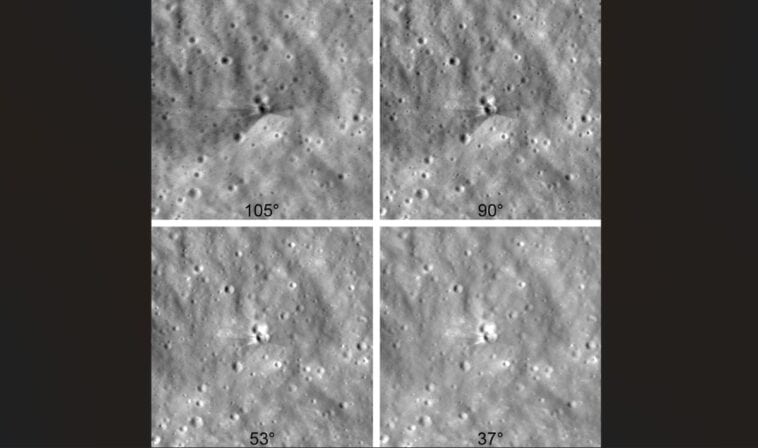
A SpaceX rocket stage that spent a year wandering through space struck the moon at 5,400 mph on August 5, leaving behind a unique scar on the lunar surface.
NASA recently released new photographs of the aftermath, which reveal a crater measuring about 60 feet across and less than 10 feet deep. Surrounding the impact, two sets of dark and bright streaks radiate outward, spreading much like butterfly wings.
Agency scientists attribute this distinct ‘V-shaped’ pattern to the rocket’s low-angle impact, noting that the dark streaks sitting just under the surface consist of material exposed across eons by solar wind, cosmic rays, and micrometeorite strikes. The bright streaks, meanwhile, are composed of fresher, deeper material that had never before been exposed to the lunar surface.
Origin of the impact
Before it became debris, the derelict SpaceX Falcon 9 stage had a productive life. Its upper stage carried two private moon landers into space in 2025, specifically Firefly Aerospace’s Blue Ghost and ispace’s Resilience, laden with experiments and a small rover, as part of NASA’s push to hand lunar delivery over to commercial operators.
Documenting the aftermath of the mission proved to be a technical feat. NASA’s Lunar Reconnaissance Orbiter (LRO) maintains a polar orbit 60 miles above the lunar surface, covering a mile every second, while the moon rotates underneath it.
To capture the images, flight controllers had to perform a delicate maneuver to tilt the entire robotic spacecraft so its cameras pointed the right way. It took six days for the impact site to finally align with the orbiter’s path.
While South Korea’s Danuri spacecraft was the first to return with images of the site, the LRO, which has been circling the Moon since 2009, provided the detailed follow-up needed for analysis.
Sources: NASA, Firefly Aerospace, Korea Aerospace Research Institute, NYP