
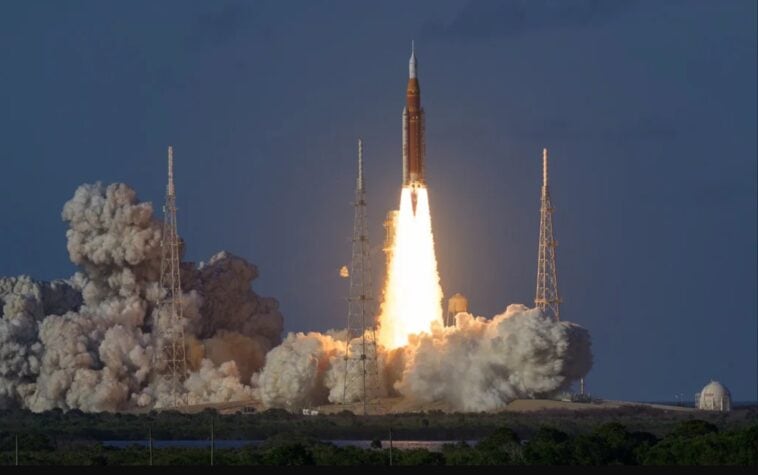
NASA’s Artemis II launch earlier this year created huge temporary holes (depletions in electron density in the ionospheric plasma) in a layer of Earth’s upper atmosphere that GPS signals pass through, and researchers say the effect could cause errors in GPS positioning.
The findings were detailed in a preprint study that was released on the ESS Open Archive platform ahead of peer review. Researchers at National Cheng Kung University in Taiwan analyzed data from ground-based GPS receivers that U.S. institutions normally use to track the movement of the Earth’s tectonic plates.
The team found that each hole stretched roughly 3,100 miles (5,000 kilometers) across North America, and the disturbances unfolded across different flight phases following the space mission’s launch on April 1 from Kennedy Space Center in Florida.
The study recorded three distinct disturbances: the first caused by the rocket’s core stage during launch, a second from an upper-stage apogee-raising maneuver about 115 miles above Earth, and a third from the trans-lunar injection burn that sent the Orion spacecraft toward the Moon.
The team said the disturbances were more intense than those from any earlier rocket launch, including SpaceX’s Starship test flights, and could have shifted positions for single-frequency GPS receivers by several meters, though modern dual-frequency systems can correct for such delays.
“This is the first report of such large-scale disturbances generated during a spacecraft’s orbital maneuvers,” the authors wrote in the study, noting that the upper-stage burns generated far stronger shock waves than the liftoff itself.
While aviation systems can filter out these atmospheric delays, the researchers warned that standard single-frequency devices, widely used in commercial drones and autonomous vehicle sensors, remain vulnerable to discrepancies of that size.
It’s worth noting that no GPS failures, navigation problems, or accidents have been linked to the launch so far.
Sources: NASA Space Launch System, ESS Open Archive, NASA Artemis II, Space.com, WUSA9