
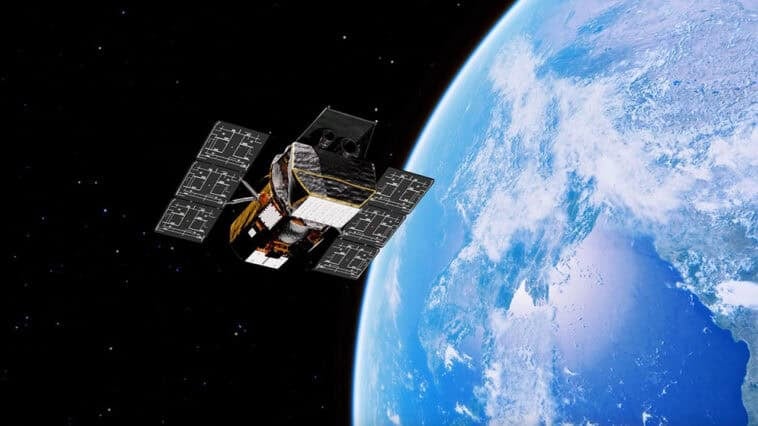
After spending more than two decades exploring the universe, one of NASA’s space telescopes is approaching an unexpected end to its mission. The Neil Gehrels Swift Observatory is expected to fall back toward Earth this week after a rescue attempt failed to prevent its descent. The aging spacecraft has spent years helping scientists study powerful cosmic explosions and other distant phenomena, but now it faces a fiery return to our planet. What caused the telescope to lose its place in orbit, and could any pieces survive the journey through Earth’s atmosphere? Read on to find out what happened and what scientists expect during its dramatic return.
A fiery end to a cosmic first responder
After nearly 22 years of tracking down the universe’s most violent explosions, NASA’s Neil Gehrels Swift Observatory is coming home. The 3,200-pound spacecraft is projected to re-enter Earth’s atmosphere early Wednesday around 3:30 a.m. EST, though experts note a wide 11-hour margin of error on either side.
While most of the satellite will incinerate during its rapid descent, a few dense components, specifically heavy tungsten parts and thick mirror elements, might survive the intense heat of re-entry. Given Earth’s topography, any leftover debris will most likely splash down harmlessly in the ocean. However, because its trajectory covers almost every continent except Antarctica, potential landing zones technically stretch across large swaths of the United States, China, Africa, and Australia.
Despite the dramatic descent, space officials emphasize there is very little reason for concern on the ground.
“The risk of harm coming to anyone on Earth is unlikely — approximately 1 in 2,100,” NASA noted in an official statement.
Two decades of unraveling space’s biggest mysteries
Launched on November 20, 2004, Swift was built for rapid-response astronomy. The spacecraft earned its name from its signature ability: swiveling on a dime to lock onto short-lived gamma-ray bursts, supernovas, and star-shredding black holes before they faded away.
Operating like a high-tech “first responder” in low-Earth orbit, Swift instantly detected high-energy cosmic events and tipped off larger observatories, including the Hubble and James Webb space telescopes, so they could zero in for detailed follow-up studies. Over its lifetime, Swift built a monumental legacy:
- 2,000+ gamma-ray bursts cataloged
- 1,400+ exploding stars observed
- Countless comets, asteroids, and extreme deep-space phenomena mapped
For the team behind the mission, watching the spacecraft fall feels bittersweet, even if it was always part of the long-term plan.
“We’ve known this day would come since before Swift was launched. At least in low-Earth orbit, what goes up must come down. And that end is catastrophic,” said John Nousek, an astronomer at Pennsylvania State University who led the mission’s control team.
High solar activity and a failed robotic rescue
Swift’s retirement arrived sooner than expected due to recent, intense solar storms. The surges in solar activity expanded Earth’s upper atmosphere, generating atmospheric drag that steadily pulled the telescope out of its stable orbit.
In an effort to save the aging satellite, NASA partnered with commercial space company Katalyst Space to pull off a last-minute orbital boost. The plan centered around “Link,” a specialized three-armed rescue robot launched in July to rendezvous with the observatory and lift it into a safer orbit.
However, Link encountered critical troubleshooting issues shortly after launch, stalling between 7 and 9 miles (12 to 15 kilometers) away from Swift. Unable to complete its rendezvous, the rescue craft was abandoned and re-entered the atmosphere in September.
Final legacy and the search for a successor
Once the rescue mission was scrapped, ground teams squeezed every remaining second of science out of the telescope. Swift went right back to work, capturing fresh gamma-ray bursts and high-energy events throughout the late summer.
By late October, however, the observatory dropped too low to maintain precise aiming control. Engineers officially shut down its instruments, leaving the spacecraft to drift into its final orbital decay.
As Swift prepares for its final journey, the astronomical community is celebrating its decades of groundbreaking discoveries while urgently looking for ways to fill the crucial void left by the loss of the sky’s primary swift-pivoting monitor.
Source:
New York Post