
The budget smartphone game is becoming tough to play, with rising component prices squeezing margins on cheap phones. But, it’s a game Infinix is still playing, especially when it comes to gaming phones. The Infinix GT 50 Pro is their latest low-cost performance phone, and for around €330, you get a lot — an excellent display and a rock solid second-tier chipset, in addition to a solid rear camera and better-than-expected battery life. Combine that with a few pleasant surprises for gamers, and you get a compelling value option.
Design and build
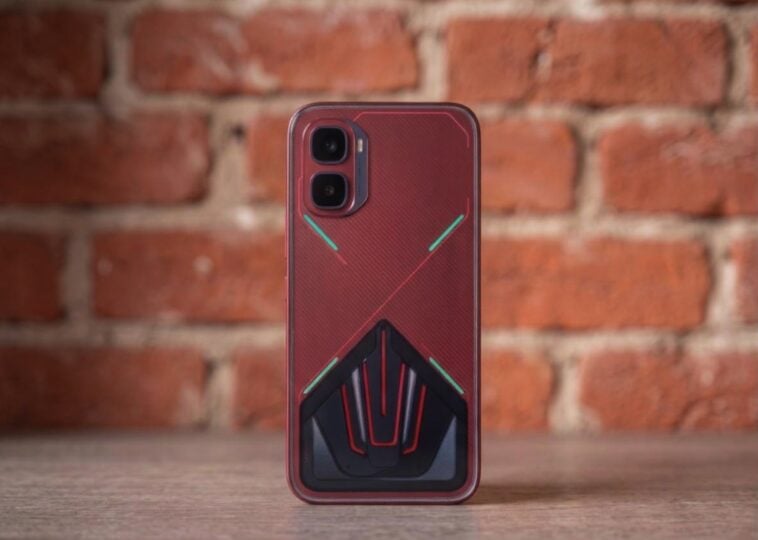
The Infinix GT 50 Pro is a standard 6.78-inch plastic phone, but credit to Infinix for giving it a little personality. The striped back is jazzed up with some gamer-aesthetic RGB lights that can be customized in the phone’s settings (they’re off by default). The bottom half of the back displays the phone’s liquid cooling system, which you can watch in action when the phone’s in use. In the top left, you’ll find the phone’s dual-camera array, which includes the main and ultrawide cameras.
For the size, the phone feels light in hand, and despite the plastic build, it has a solid, sturdy feel to it. However, it’s only got an IP64 rating, making it dust-proof but only water-resistant up to light rain — big splashes and full submersion may damage the phone. The display is protected by Corning Gorilla Glass 7i, which can get scratched up after a while, but offers solid protection against shattering.
On the right side of the phone, you’ll notice two touch buttons on the top and bottom. Those are programmable trigger buttons, like you’d find on a gaming controller. We’ll go in depth in the performance section, but they are pressure-sensitive, and won’t be activated with just a touch. While they are primarily there for gaming, they can be configured to serve other purposes like snapping photos.
Performance
At the core of the Infinix GT 50 Pro is the Mediatek Dimensity 8400 Ultimate chipset, with 12GB of RAM. That’s at the top end of Mediatek’s second-tier chipsets, and still has pretty impressive top-end processing power. It’s more than enough to handle everyday tasks smoothly, and it can handle higher end gaming well, but not perfectly.
During an hour of playing Genshin Impact with 60fps enabled, at max graphics settings, and at max display brightness, I got a steady 50-51fps, with rare frame rate dips during busier moments of gameplay. The phone handled cutscenes perfectly, which doesn’t always happen with lower-cost gaming phones, so that was nice to see.
Part of the credit goes to the phone’s liquid cooling system, which sees a system of pipes snake around the back of the phone, actively drawing heat away from warmer areas of the phone. It does a great job of heat dissipation, as the phone felt only a little warm after an hour of gaming, without noticeable hotspots around the chipset or battery.
Normally this is where we’d compliment the phone for solid mid-range performance and move on, but Infinix has thrown a couple extra features into the mix. First are the touch trigger buttons mentioned in the previous section. Those two buttons can be mapped to zones on the touchscreen, so you’ll need to map the buttons individually for different games, depending on where the touchscreen controls for each game are. They’re pressure-sensitive, so simply touching them won’t cause an unwanted press.
The buttons work reliably, and I was really impressed by the level of customization. By default, I thought they were a bit too sensitive, but the amount of pressure needed for activation can be adjusted. You can also map long presses and taps separately, and long presses can be assigned to rapid tap, which works great with shooters. So, you essentially get four mappable buttons, with the option to save multiple presets for different games. On top of that, you can tap those trigger buttons far faster than the touchscreen can recognize taps. No notes — it’s a super cool idea for a gaming phone, and it’s executed just about flawlessly.
Our review unit also came with the GT Magcharge Cooler 2.0, which is sold separately. It’s a small puck that acts as an external heat sink and a wireless charging pad. The magnetic surface gets frosty when plugged in, while a small fan blows off dissipated heat. On the charging side, the puck is capable of pass-through charging, meaning it can circumvent the battery and power the device directly, reducing strain on the battery and hopefully helping to make the battery last longer over years of use.
It works remarkably well. When in use, battery life doesn’t tick down much, and in the same gaming test described above, I got very nearly stable 60fps gameplay (using the puck unlocks another higher performance option in the OS’s gaming utility).
I also stopped using it as soon as I could. The problem is that it works a little too well — the fan blows out some very hot air to keep the phone cool. If you’re holding the phone like normal (notably, with fingers in position to use those rad trigger buttons), the fan is blowing all that hot air right onto your hands. So while the phone stays cool, the heat from the fan makes the whole setup too uncomfortable to hold for more than a few minutes, and you do have to put up with the noise of the fan, too.
I didn’t find the small improvement in performance to be worth it, especially considering the cooler is sold separately. That’s money I would rather put towards a more powerful phone, if I was that dissatisfied with 50fps gameplay.
It’s also worth noting that the puck requires the use of the included protective case, which has a magnetic ring to hold the puck in place. And, to be clear, it’s not an external battery pack — the puck doesn’t have its own battery and needs to be plugged in during use, so you can’t use it on the go unless you have a separate external battery to use. That would work, I guess, but then you’re using an accessory for an accessory, and it all starts to seem a bit too inconvenient.
On the connectivity side, the GT 50 Pro is a 5G phone that has eSIM compatibility for frequent travelers. There’s also Wi-Fi 6, Bluetooth 5.4, an IR blaster, an FM radio, and an NFC chip. We’re relieved to see NFC, which enables mobile payments and is something we occasionally see left off phones at this price.
Display and audio
As expected from a gaming phone, the GT 50 Pro doesn’t fumble the display. The 6.78-inch 2644×1208 LTPS AMOLED display looks sharp and vibrant during gameplay and movies alike. A peak local brightness of 4500 nits makes for great contrast, although the phone doesn’t meet any HDR certifications. Overall peak brightness is 1600 nits, which is more than enough for use in direct sunlight. The display has a 144Hz refresh rate, which is probably higher than you’ll ever need when using this phone.
Unfortunately, on the audio side, Dolby Atmos processing can’t save a weak set of speakers. At least you get a set of speakers, though — the GT 50 Pro has dual speakers (one being in the earpiece), at a price range where we sometimes see just one. However, those speakers sound tinny and weak, with almost no bass and a lot of distortion at higher volumes. The display is fantastic, but you’ll want a good set of headphones during gaming to make the whole experience shine.
Battery
Given the solid performance and the low price, I feared that battery life might be a weak point with the Infinix GT 50 Pro, but that didn’t turn out to be the case. The 6,500mAh battery isn’t big or small by 2026 standards, but this performance-forward phone manages to use it well.
One hour of Genshin Impact at max settings, 60fps turned on, and maximum display brightness used up 17% of battery capacity, and an hour of video at max display brightness used up 5%. Those results aren’t particularly bad or good compared to those of other budget and mid-range phones we’ve reviewed. I still wouldn’t call battery life a selling point here, but it’s not a weakness, either.
When it comes time to recharge, the GT 50 Pro works with up to 45W wired charging adapters and up to 30W wireless charging pads. With the included wired charging adapter, the phone recharged to 9% in 5 minutes, 17% in 10 minutes, 48% in 30 minutes, and 89% in one hour. Again, not particularly bad or good for the price range.
Cameras
The Infinix GT 50 Pro has two rear cameras — a 50MP main camera with phase-detect autofocus and optical image stabilization, and an 8MP ultrawide camera with autofocus. The main camera is capable of video recording up to 4k 30fps. On the front, there’s a 13MP selfie camera, with neither autofocus nor optical image stabilization.
Considering that this is a gaming-forward phone, I didn’t expect much out of the cameras. I was pleasantly surprised — colors came out vibrant, and there was more sharpness, especially in background details, than I thought I’d get. While it’s clear that photography isn’t central to this phone’s identity, I wouldn’t say the cameras are weaknesses, either.


In the two shots above taken with the main camera, there was a good amount of depth to the colors, especially the greens in the second photo. The people in the background on the beach came out well defined, where I expected a little more blurriness, and balance was overall pretty good, even when there was less light on an overcast day.

The main camera is capable of 2x optical zoom shots, which also came out well. I didn’t feel like I lost too much in the way of sharpness, although there is a bit more blurriness in some of the smaller details. Still, for quick point-and-shoot shots, I was happy with the results.

As expected, the 8MP ultrawide camera struggles a bit more with color reproduction and sharpness, and I felt like the photos turned out a bit darker. The ocean looks noticeably more blurry than in the main camera shots, too. Not bad, but the step down in quality is noticeable.

Low-light shots weren’t too bad. There’s a lack of focus even in the subjects, but photos at least come out well-lit and without muted colors. From my experience with it, you’ll probably have more luck with indoor shots and/or closer subjects than with something like cityscapes at night.

Portrait mode shots were terrific — up close, colors really shine, I was very surprised to see how well the camera defined the contours of subjects. The flowers here came out sharp, with minimal blurring around the edges. The shots came out generally well-lit and balanced, with few dark spots. Again, for the price and for this being more of a gaming phone, the results exceeded expectations.
Software
The Infinix GT 50 Pro runs Android 16 with the XOS 16 overlay. Infinix’s custom OS is a little more heavy-handed than that of some other budget options, but most of the changes are innocuous or aesthetic (there’s a pre-installed app theme with a vaguely gamer look to it). They go a little heavy on bloatware, with quite a few pre-installed games and system apps in addition to an app download recommendations folder.
There’s a little AI goofiness. There’s a folder for “AI recommendations” on the home screen which recommends, as best I can tell, my most used apps. Most everything else is on the level. Infinix has their own AI agent, Folax, although you can switch to other options (DeepSeek, ChatGPT, Gemini, etc) within their AI utility, which enables image generation, note summaries, transcription, and AI chat/voice queries history. You also get the usual suite of AI-powered photo editing features for touching up photos or removing unwanted background objects.
Sustainability
We love low-cost phones, but we love them even more when we know we can spread that low cost out over more than four or five years. About $350 for a phone is great, but if we can get that $350 to mean $70 per year of use, the value proposition becomes all the more intriguing.
The Infinix GT 50 Pro has a shot at having that kind of lifespan. Infinix is guaranteeing three years of OS updates and five years of security patches, which is great at this budget price range. The phone feels solid in hand, and Corning Gorilla Glass 7i should prevent the display from shattering, even if scratches are likely over the course of a few years.
The only thing that could end this phone’s life early is an accidental dunk in water, as it only has an IP64 rating. Battery degradation could be a problem, too, especially with all the heavy gaming use this phone is sure to get. It makes me wish I could take more advantage of the Magcharge accessory’s pass-through charging feature, but it’s just too uncomfortable to use.
Pricing and availability
The Infinix GT 50 Pro has gotten a limited global release, hitting a handful of countries including Nigeria, Indonesia, and the Philippines. Price varies by country, but is typically around €330/$380. That price will get you 256GB of storage, and there is a 512GB option — 12GB of RAM, either way.
Bottom line
The Infinix GT 50 Pro is just a flat-out great gaming smartphone for the price. Getting stable 50fps on max settings in a phone under $400 is a big win, and this phone has an excellent display to take full advantage of that performance. I also really don’t want to undersell the touch trigger buttons, which immediately elevated gameplay for every mobile game I tried. It’s a wonderfully implemented feature and gives this phone a huge leg up on its budget and mid-range competitors.
What could have been downsides are instead good enough. Battery life is fine, if not outstanding, and while you only have wide and ultrawide options on the rear camera array, both performed better than expected for a budget phone focused more on gaming.
Do I wish the Magcharge Cooler was more practical? Sure. But the Infinix GT 50 Pro doesn’t really need it. As it is, the phone provides excellent price-to-performance value without skimping too much on any other feature, and the liquid cooling system does its job well enough. If you’re looking for a great gaming phone for under $400, it should definitely be on your shopping list.