
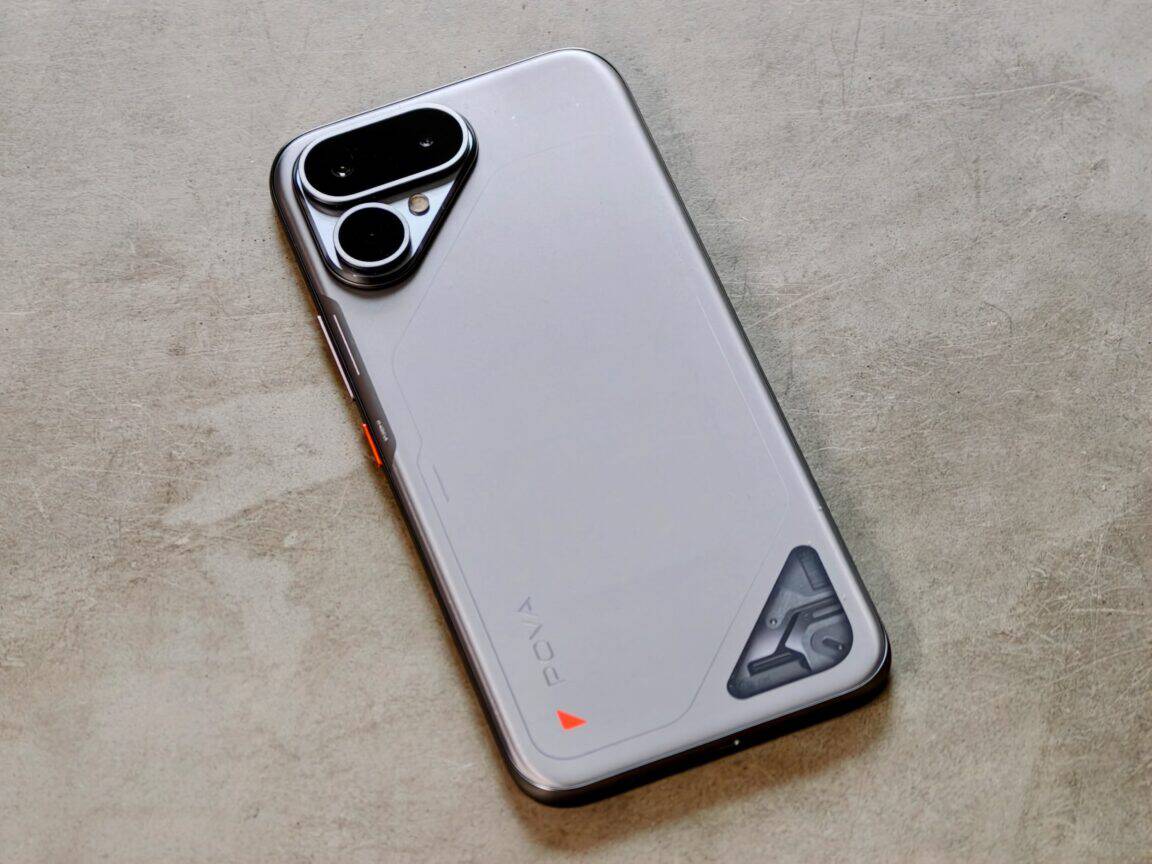
Tecno seems like they’ve got a smartphone to fill just about every niche. One of their latest releases, the Tecno Pova Curve 2, wants to satisfy folks looking for a low-cost phone that is lightweight and lasts a long time, and in that it succeeds. Its sleek, curved design makes the phone light and easy to pocket, despite the fact that Tecno managed to fit in a battery larger than the ones we see in most phones two or three times the Pova Curve 2’s price. But, a phone in the $300-$400 range isn’t going to be perfect — as we’ll cover in our Tecno Pova Curve 2 review, plenty of sacrifices have been made to keep the price down, but ultimately, the trade-offs might just be worth it.
Design and build
One of the biggest selling points of the Tecno Pova Curve 2 is how small it is — at 7.42mm thick and 195g, it’s one of the thinnest and lightest 6.78-inch smartphones on the market, making it very comfortable to pocket and to hold for long periods of time.
It’s got a plastic frame and only has an IP64 rating, meaning it’s only protected from light splashes of water, so it’s a phone you’ll want to be careful with — it won’t hold up to drops and dunks in water as well as more expensive phones. Corning Gorilla Glass 7i protects the display, which historically has been great at preventing shattering, but just OK at preventing scratches.
True to its name, the Pova Curve 2 has a curved display, which tends to be a love-it-or-hate-it feature. Fortunately, I had a lot fewer problems with accidental touches on the Pova Curve 2, which is usually my main complaint with curved displays. Even when playing games in landscape orientation, accidental touches were kept to a minimum, and after a while I came to be impressed with how the slight curves on the display and back made the phone comfortable to hold for long periods of time.
The camera bump in the rear isn’t too pronounced, taking up just the top corner on the left side of the phone. While it looks like there are three cameras housed in there, there are just two — a 50MP main camera and an auxiliary 2MP macro camera, which we’ll talk more about in the camera section.
The Tecno Pova Curve 2 comes in Mystic Purple, Melting Silver, and Storm Titanium colorways.
Performance
The Tecno Pova Curve 2 uses the Mediatek Dimensity 7100 chipset, which is a relatively new mid-range/budget option. It has an 8-core CPU, including four 2.4GHz cores. Those are not particularly powerful, but in daily use, the chipset is enough to make the phone smooth to use, without any noticeable hitches or slowdowns. The phone can be purchased with either 8GB or 12GB of RAM — our review unit had 8GB and still ran fairly well, so the 12GB configuration should handle heavy workloads even better.
When pushed, the Pova Curve 2 performs a little better than expected. Playing Genshin Impact for an hour with the phone’s performance mode turned on and with max graphics settings, full display brightness, and 60fps turned on, I usually got between 30 and 35fps, with occasional dips under 30 when there was more action than usual on screen. The phone only got a little warm after an hour, so thermal management seems to have been implemented well. At medium or even high graphics settings, you can get a pretty solid gaming experience considering the low price of this phone.
No major corners cut on connectivity, fortunately. The Pova Curve 2 has 5G connectivity, as well as an IR blaster and an NFC chip for mobile payments. No Wi-Fi 6 or 7 capabilities, though, so depending on what your last device was, download speeds on Wi-Fi might be a little slower than what you’re used to. There’s also an optical fingerprint sensor, which works quickly and consistently.
Display and audio
Smartphone displays are fairly consistent across the board these days — it’s hard to find a phone that doesn’t have at least a 1080p AMOLED display at any price range. The Pova Curve 2’s display meets that exact standard, with a 144Hz refresh rate and an overall max brightness of 1600 nits (4500 nits localized). That makes for strong performance in direct sunlight and great contrast, although the phone doesn’t meet any HDR playback standards. Still, the peak brightness on this phone is around what we see on phones at least a couple hundred dollars more expensive.
Audio is a mixed bag. Surprisingly, there’s only one functional speaker for media on the bottom of the phone. Usually the phone speaker used for calls doubles as a second speaker, but that’s not the case with this phone. That solo speaker does punch above its weight, thanks to Dolby Atmos processing — different instruments sound distinct and clear. Volume gets very loud, but distortion and cracking can only be heard at or near max volume. Bass is a little weak, but it’s not any worse than most other smartphone speakers. Overall, audio performance is good for the price, although the lack of a second speaker is a little disappointing.
Battery
Mid-range and more affordable phones usually have one outstanding feature, and for the Tecno Pova Curve 2, that’s definitely the battery. The 8,000mAh battery inside is larger even than what we’re seeing in many flagship phones this year, and the fact they fit it in a phone this thin is a remarkable achievement.
It’s not just remarkable on paper, either. Playing Genshin Impact for one hour with max brightness, performance mode on, and with max graphics settings only used up 13% of battery capacity, which is one of the best results I’ve seen on any mid-range phone in the past couple years. An hour of video at max brightness only used 5% of capacity, also a fairly impressive result compared to other mid-range phones.
The short version: if you value battery life above all else when phone shopping, the Pova Curve 2 is the phone for you. It uses very little power when idle, and with balanced, everyday use, the phone regularly pushes two days of use.
Charging isn’t as impressive as many peers in the mid-range category. The phone can only take up to 45W charging, so no getting to full in under an hour here. However, it only takes an hour to get back to about 50% capacity, and given the phone’s stellar battery life, that alone is good for a full day’s worth of use. There’s no wireless charging, so if you’ve invested in wireless charging gear, you’ll want to look elsewhere.
Cameras
Battery life is outstanding, but the other side of the coin is the camera array, which appears to be where most of the cost cutting was done. The Pova Curve 2 only has one independently functioning camera, a 50MP wide camera with phase-detect autofocus, but no optical image stabilization. The second camera is an auxiliary 2MP macro camera, which helps add depth to portrait shots taken with the main camera. So, no dedicated zoom camera, which is often the case at this price range, but also no ultrawide camera, which we usually do see. The front selfie camera has a 13MP sensor, which is on the lower end even for more affordable phones.
There is an AI-assisted FlashSnap mode, which is meant to assist with action shots. In essence, it’s a burst shooting mode that takes several pictures in rapid succession, with AI choosing the best of the bunch. It’s a good feature in theory, and one we see on many other phones, but the lack of optical image stabilization makes it tough to get clear action shots on this phone.

Pictures taken with the 50MP main camera are just OK. The colors come out a little muted and there’s a lack of sharpness throughout, with smaller details coming out a little fuzzy. They’re serviceable shots, but nothing amazing.

The 2x optical zoom shots have the same issues, but I didn’t notice too much of a drop in quality from the 1x shots. There is a little more blurriness in the background, though, and I suspect that the lack of optical image stabilization didn’t help.

On the whole, portrait mode pictures came out a little better. The lack of optical image stabilization isn’t as important with these shots, and the 2MP auxiliary macro camera helped to bring the subject into focus in contrast to the background. The results look realistic, as opposed to over-processed, and the subjects are usually outline clearly with little blurring around the edges.

I thought low-light shots weren’t bad, all things considered. They aren’t particularly crisp, and parts of the image with less light come out lacking in detail and color, but there’s little of the graininess or distortion that we sometimes see on phones in this price range.
Software
The Tecno Pova Curve 2 runs Android 16 with Tecno’s HiOS 16 overlay out of the box. One of the central features of HiOS is Ella, Tecno’s AI assistant. It’s got the usual slate of AI assistant features — AI-powered search, summaries, translation and interpretation, and scheduling and calendar help. While Ella is the default AI assistant, you can change to a number of other options, like DeepSeek, ChatGPT, or Gemini.
The Pova Curve 2 also has the usual suite of AI-powered photo editing features. You can use the phone’s gallery app to remove glare, shadows, reflections, or unwanted people or objects. You can also extend a photo, with AI analyzing the contents of the photo and adding extra background. As usual with AI, it’s a mixed bag — usually, the bigger the change, the more obvious it is that something’s been altered. In particular, that’s almost always the case with the AI Extender feature.
One thing we’re happy to report is that despite bordering on budget in terms of pricing, bloatware has been kept to a minimum. Aside from HiOS system apps, there was just one pre-loaded game (Crush Block), which can be uninstalled. We’ve seen folders worth of junk on phones $100-$200 more expensive than the Pova Curve 2, so credit to Tecno for keeping it light.
Sustainability
We like it when we have reason to think that a phone can last for at least four or five years — not only does that cut down on electronic waste, it helps stretch the cost of the phone over a longer time, giving you more value. With the Pova Curve 2, it’s a mixed bag. The IP64 rating is a bit of a miss, considering that IP68 ratings for full waterproofing have almost become industry standard. This is the rare phone that won’t survive immersion in water, and given its small, plastic frame, the Pova Curve 2 will demand a little more caution than usual.
Tecno is only guaranteeing two years of OS upgrades and three years of security patches, which is on the lower end of support guarantees. Along with the lack of physical durability, the lack of longer support guarantees means this is a phone you’ll only keep for two or maybe three years, which is a little disappointing.
Pricing and availability
The Tecno Pova Curve 2 is available now in a number of global markets in 8GB RAM/128GB storage, 8GB RAM/256GB storage, and 12GB RAM/256GB storage configurations. Color options include Mystic Purple, Melting Silver and Storm Titanium. Pricing varies by market, but the starting price usually converts to somewhere around $300, putting the phone at the lower end of the mid-range category.
Bottom line
Considering that the phone starts at $300, a lot of the Tecno Pova Curve 2’s limitations don’t seem too bad. It performs better than expected for the price, and the audio and display are great for gaming and watching videos, even if the lack of a second speaker is a disappointment.
The main reasons to get the Pova Curve 2 are its large battery and light weight, and both are noticeable on paper and in use. The phone is comfortable to use for longer spans of time and to carry around in a pocket, and I really liked that the curved display was subtle enough to prevent most accidental touches. Battery life is about as good as it gets, with two-day use possible without even trying to conserve power.
On the other hand, you’ll have to make peace with a much more limited camera array than usual. Not getting a dedicated zoom camera isn’t too surprising at this price, but no ultrawide camera is surprising. The 50MP wide-angle camera that is here is nothing too special, either, and optical image stabilization is sorely missed.
We’d love to see a little more in terms of durability and upgrade guarantees. But at around $300-$400 it still represents a great value. If you take a lot of pictures with your smartphone, there are much better options even at this price, but if you just want a smartphone that nails the basics alongside a unique and thin formfactor that doesn’t give you battery anxiety, the Tecno Pova Curve 2 is worth a look.