
Xiaomi loves their smartphone cameras — their partnership with the photography experts at Leica has been a fruitful one for many years. The Xiaomi 17T is one of the best results of that partnership yet, bringing a truly high-end smartphone camera array to the mid-range market. Granted, it’s at the higher end of that price range, but as we’ll see in our Xiaomi 17T review, there’s a lot here to love for under $1,000, and the cuts to the spec sheet to get the price down aren’t that deep or numerous. If you don’t mind paying extra for better cameras, this is a smartphone well worth considering.
Design and build
This is one reason the Xiaomi 17T isn’t a flagship — it has a plastic build, rather than aluminum. That said, the phone doesn’t feel cheap in hand, and the metallic finish on the colorways makes it look a lot more expensive than it is. It’s noticeably light at 200g, and I think the 6.59-inch display hits the sweet spot — comfortable to pocket without feeling like you’re lacking in display size.
That display is completely flat — no curved display here — and is protected by Corning Gorilla Glass 7i, a common choice for mid-range phones. It’s not the most scratch-resistant option that Corning has, but historically it has done well in preventing screen shattering and scratches from light wear and tear. The phone is rated IP68, making it both dust- and waterproof.
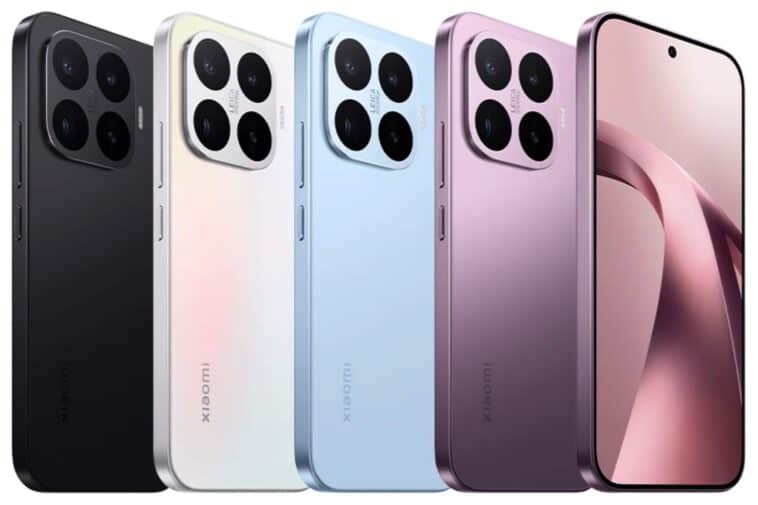
The rear of the phone has a camera array that doesn’t stick out too far. It houses four sensors, including the main camera, the zoom camera, and the ultrawide camera (the fourth looks like it houses the infrared scanner). It’s subtle enough to where the phone is stable if you’re trying to use it while it’s laying flat on a table.
Color options include violet, blue, opal white, and black. Pinks and purples are hit or miss, but the light violet shade and metallic tint on the Xiaomi 17T look fantastic — it’s definitely the standout colorway of the bunch for us.
Performance
The Xiaomi 17T uses the Mediatek Dimensity 8500 Ultra chipset, which is an upper mid-range chipset. The phone comes with 12GB of RAM, with storage options of 256GB and 512GB. That chipset includes an 8-core CPU, which has one stronger core with a 3.4GHz clock speed, three 3.2GHz cores, and four more efficient 2.2GHz cores. That’s a good mix of performance and efficiency on paper.
In practice, the 8500 Ultra is a strong performer, but if you’re a gamer, you’ll notice the dropoff from the premium 9000 tier. When playing games like Genshin Impact on the highest settings, gameplay doesn’t quite hit a steady 60fps, with rare frame rate drops when there’s a lot of action on screen. It seemed to struggle a surprising amount with rendering cutscenes, though.
I think the sweet spot for the Xiaomi 17T is to play games at high, but not the highest, settings. That’s not just because of the slight performance dropoff on max settings — the phone also got pretty warm when playing games at max settings. Not quite uncomfortably so, but after an hour or so, the heat was more noticeable than with most mid-range phones we’ve reviewed recently.
Gaming aside, the phone handles wonderfully. It has the same kind of snappiness and fluidity as flagship phones do. It’s a subtle distinction, but when using it side-by-side with other mid-range phones we’ve got on hand, we can tell it handles a cut above the rest.
For connectivity, the Xiaomi 17T has Bluetooth 6.0, Wi-Fi 6 (both dual-band and tri-band), NFC for mobile payments, and an IR blaster. There’s also an optical fingerprint sensor under the display that works quickly and consistently.
Display and audio
The display is another part of the phone that has a premium look to it, separating itself from other mid-range phones. It’s got a 2756 x 1268 AMOLED display with a 120Hz refresh rate, support for HDR10+, Dolby Vision processing, and a peak brightness of 3500 nits. That high brightness makes high-contrast scenes in videos shine, and the sharpness of the higher resolution is appreciable on the 6.59-inch display. It definitely contributes to the overall feeling of fluidity and sharpness that this phone has.
The Xiaomi 17T display has also been put together to be easier on the eyes. The phone received TÜV Rheinland Intelligent Eye Care certification. To earn that, Xiaomi instituted their own system of screen flicker and dimming management, which seemed to work well — I didn’t notice the phone dimming unexpectedly, even if I’m not sure my eyes are sensitive enough to tell that this display is any better than another for eye health.
While most of us will be using headphones of some sort, it never hurts to have a decent set of speakers on a smartphone, and the ones here are more than decent. The stereo speakers sound clear and distinct thanks to Dolby Atmos processing, and bass response is about as good as it can be for a smartphone that doesn’t have a dedicated woofer (yes, those exist). The one knock on the speakers is that max volume could stand to be a little bit louder.
Battery
Battery life is usually a strength of mid-range phones, but it might be the weakest link for the Xiaomi 17T. The global version of this phone has a 6,500mAh battery, which for 2026 isn’t particularly large or small. But, with an upper mid-range chipset that’s a little more power hungry, that capacity doesn’t afford the Xiaomi 17T as much use time as with other mid-range phones.
An hour of playing Genshin Impact at max settings, 60fps, and max brightness used up 20% of battery capacity, which is the most I can remember of any mid-range phone with which I’ve done that particular test. An hour of video at max brightness used up 7% of capacity, which was more in line with what we usually see on mid-range phones.
Suffice it to say that the Xiaomi 17T always needed a charge at the end of the day. But, in everyday use, I didn’t run into too much battery anxiety late in the day. I think most folks will be fine, but if you’ve got a particularly long public transportation commute where you’re mostly watching videos or gaming, you’ll probably want to keep an eye on the battery.
The phone only works with up to a 67W charging adapter, which is just OK. It won’t get you to a full charge in an hour, but charging speeds aren’t bad — one hour of charging got me from dead to 48%. 5 minutes of charging only got me to 4%, though, so it’s not a phone you can plug in for a few minutes real quick and get a couple extra of hours of use.
Cameras
Xiaomi went all-out with photography on the 17T line, and while the array on the more expensive Pro model is a little better on paper, there’s not too much of a dropoff. The Xiaomi 17T has three cameras: a 50MP main camera with phase-detect autofocus and optical image stabilization, a 12MP ultrawide camera, and a 50MP periscope telephoto camera, which has phase-detect autofocus and optical image stabilization and is capable of 5x optical zoom. Those rear cameras all use lenses from Leica. On the front, there’s a 32MP selfie camera.
That’s a stacked lineup, and not just for photography. This is also one of Xiaomi’s first phones capable of recording 4k video at 60fps — on the whole, this is meant to be competitive with some of the very best smartphone camera arrays on the market.

While balance could’ve been a little better, I was happy with the main camera. Details are sharp when you zoom in, and the water in the bay looks clear, with color faithfully reproduced — it tends to look more washed out on cheaper cameras.

The Xiaomi 17T still uses the main camera for 2x shots, rather than the telephoto zoom camera. So, you’re getting the same sharpness and color reproduction. I didn’t notice a dropoff in quality, and image stabilization helps to prevent blurring.

At 5x zoom, the periscope telephoto zoom camera kicks in, and it’s terrific. The shots are just as clear and distinct as those from the main camera. I was glad to see that the sky wasn’t washed out at all, either. Again, I’d love the balance to be a little better, but if you take the time to find and/or wait for better lighting, you’re going to get some terrific results.

There is a 10x zoom option, which is digital-assisted. I usually don’t touch on digital zoom, but hats off to Xiaomi — the 10x zoom shots look pretty darn good. If you’re used to digital zoom shots coming out looking like a blurry mess, things have come a long way thanks to better processing and OIS. You’ll still want to pay some attention to the lighting around you, but even if you use 10x zoom purely for quick point-and-shoots, you’ll be happy with what you get.

Ultrawide cameras are usually the weakest on multi-camera arrays, but this one didn’t let me down. The usual washed out look I get with ultrawide smartphone cameras is not here — I thought color reproduction and overall crispness were equal to the pictures from the main camera.

Night shots were hit or miss. First the good — details are impressively sharp, and there’s minimal overexposure around strong sources of light. There’s remarkably little blurriness or muddiness. However, most of my night shots came out just a little overexposed for my taste — fortunately, there’s a pro mode available that allows you to adjust settings manually to get just the right balance. The hardware here is good enough to enable truly excellent night shots, but you won’t always get them just from pointing and shooting.

Portrait shots are a little less forgiving. Color reproduction was still pretty good, but strong light (the upper left corner, here) did make some of the flowers look washed out. I would’ve liked tighter focus on the group of flowers in the foreground, too. Again, you can definitely get good results from portrait modes, but you’ll still need to do a little work with angles and lighting. The hardware and software are pretty good, but they won’t cover for everything.
Software
The Xiaomi 17T runs Android 16 out of the box with the HyperOS 3 overlay. There’s only one folder with a handful of pre-installed apps (the usual suspects for Xiaomi, like WPS Office, Amazon Music, LinkedIn, AliExpress, and TikTok), but otherwise the bloatware situation is pretty clean, which we’d expect at this price.
There doesn’t seem to be much here in the way of unique AI features. Instead, buying the Xiaomi 17T gets you a free three-month trial of Google AI Pro, which includes more advanced AI features and some cloud storage. Like usual with Android, everyone’s probably better off leaning on what Google’s doing than to try to make their own bespoke versions. It makes for a cleaner user experience.
Sustainability
The sturdy build, IP68 rating, and use of Corning Gorilla Glass 7i make us think that the Xiaomi 17T should have no problem holding up to a good amount of wear and tear, including some drops — in most cases, this phone shouldn’t need to be trashed early because of physical damage.
Unfortunately, we haven’t seen any word of support guarantees. While we think it’s safe to say that Xiaomi will keep supplying the 17T with Android updates and security patches for at least a few years, I doubt it’ll be as much as the seven years that others, most notably Samsung, guarantees. The 17T is not priced like a flagship, but it’s expensive enough to where we’d like as many reassurances as possible that this is a device we could use for at least six or seven years.
Pricing and availability
The Xiaomi 17T has been released globally, although it won’t be available in the United States. The price starts at €650, which comes out to around $750. That puts it in the price tier right below flagship, so while it’s no $1k+ phone, it’s not what we would call cheap, either. That price is for the 256GB/12GB RAM configuration, and ultimately, pricing will vary by market.
Bottom line
The Xiaomi 17T is being released alongside the Xiaomi 17T Pro, which is the flagship model in the lineup. The 17T is a couple hundred dollars cheaper, and you’re really not giving up that much by going down in price. Folks who do a lot of gaming might be better served by the more powerful Pro option, but the 17T is plenty powerful enough for everyone else, and the camera quality will satisfy everyone but the most keen-eyed photographers. The display is larger on the Pro model, as well, but personally I prefer the 6.59-inch display of the 17T.
If there’s any negative about this phone, it’s the battery life — while the 17T should last through the day for most people, it might struggle on days with heavier use, and the charging speeds aren’t particularly fast when compared to other mid-range options.
But, that’s a small downside for a phone that otherwise impresses with a look and feel that matches some of the best flagship phones on the market. The phone has a satisfying, fluid feel to it, and the display and stereo speakers are a cut above the usual mid-range offerings. Add in HyperOS 3, an Android overlay that keeps things light, and you have a pretty compelling smartphone for anyone who wants the flagship experience without having to pay near $1,000 for it.