
A gene treatment called optogenetic therapy has partly restored sight in legally blind patients, and a new study shows that the treatment appears to be safe, according to an international team of researchers.
The approach uses light to switch nerve cells on and off, the same technique that won this year’s Nobel Prize in Physiology or Medicine.
Researchers first demonstrated the approach in a single blind patient back in 2021. The new trial expanded the work to a total of ten people. The results were published in the New England Journal of Medicine.
“This study represents an important milestone for optogenetic vision restoration. It demonstrates that the effects first observed in a single patient can be reproduced across several patients and provides a foundation for developing more sensitive and effective future therapies,” said Stefan Futterknecht, a study co-author and researcher at the Institute of Molecular and Clinical Ophthalmology Basel (IOB) who led the data analysis, in a statement.
All 10 trial patients had advanced retinitis pigmentosa, a group of inherited eye diseases that affects more than 1.5 million people around the world. The disease destroys the cells in the retina that sense light while leaving other cells, called ganglion cells, mostly intact for longer.
“These results show that even in people with profound vision loss, the visual system retains a remarkable capacity to process new information,” said study co-lead author Dr. José-Alain Sahel, chair of ophthalmology at Pitt and director of the UPMC Vision Institute, in a statement.
“Potentially, the approach could also help patients with other blinding diseases in which the eye’s light-sensing cells have been lost, but other retinal cells, especially retinal ganglion cells, remain viable,” Sahel added.
How the procedure operates
Patients receive a single injection in the eye that makes their remaining ganglion cells react to light. They then wear special goggles that turn what’s in front of them into pulses of light, allowing them to perceive a black-and-white image. Because the approach targets cells that survive the disease rather than the specific gene that caused it, the treatment works regardless of the underlying mutation.
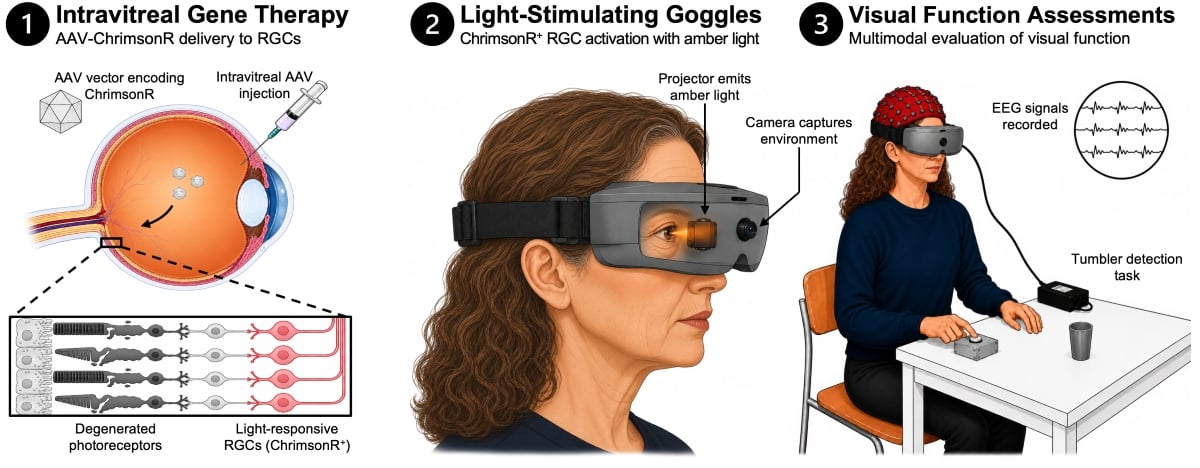
In the trial, seven of the 10 patients experienced increased light sensitivity, with six achieving a clinically meaningful improvement. Four of the eight participants, meanwhile, tested on functional tasks, were able to locate and touch objects like a notebook, find a door, or walk along a line while wearing the goggles.
Researchers observed that those who practiced more with the goggles tended to do better. Only one serious eye-related side effect was reported (a temporary blockage of blood flow in the retina that cleared up within minutes); milder eye-related side effects were common.
While the current therapy only restores low-resolution perception rather than normal eyesight, the researchers said the findings provide a working blueprint to engineer more sensitive, higher-resolution treatments in the future.
Sources: The New England Journal of Medicine, UPMC, GenSight Biologics, GlobeNewswire, The Guardian