
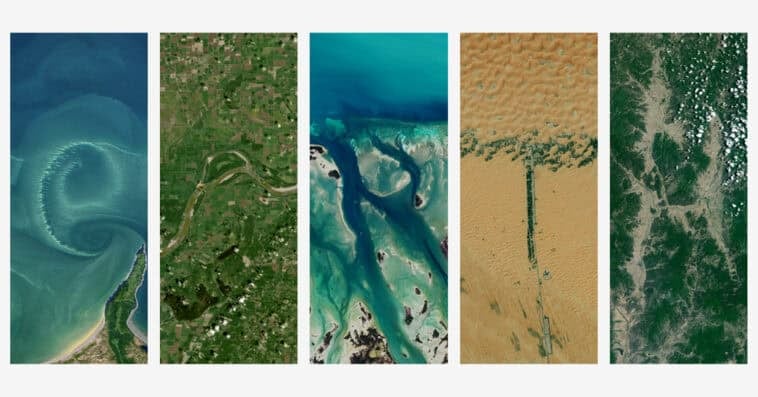
Ever wondered what your name looks like from 400 miles above Earth? While NASA is best known for peering into the deep reaches of the cosmos, its latest project brings the focus back to our home planet with a personalized, artistic twist that is quickly going viral. By tapping into a massive archive of over 50 years of satellite data, a new interactive tool allows you to spell your name using real-world geological features like winding rivers, rugged coastlines, and vast deserts — blending science, geography, and creativity in an unexpectedly fun way.
NASA’s Earth Day feature lets you spell your name from space
In a brilliant tribute to Earth Day, NASA’s Kennedy Space Center has launched an interactive experience that turns the entire planet into a personal stationery set. By leveraging the massive visual library of the Landsat satellite program, this new digital tool allows users to transcribe their names using the raw, untouched beauty of Earth’s diverse geography.
Rather than using standard fonts, the tool spells your name by identifying natural structures that mimic the alphabet from space. Your initials might be composed of a winding river in the Amazon, a jagged mountain ridge in the Rockies, or the circular edge of a remote coral reef.
Beyond the visual novelty, the project serves as a deep dive into planetary literacy:
- Global Context: Every letter generated comes with a precise geographic tag, revealing exactly where in the world that specific landform exists.
- Decades of Data: The imagery is pulled from the gold-standard Landsat archive, showcasing over 50 years of our changing environment.
- Educational Art: It transforms complex satellite telemetry into a playful, shareable medium, making the science of Earth observation accessible to everyone.
Whether you are a space enthusiast or just looking for a unique new profile header, this tool offers a rare perspective on how the world looks when it’s trying to say hello. You can start your own global scavenger hunt by visiting the NASA ‘Your Name in Landsat’ website.
The planet can spell your name – literally. 🔤🌍
This Earth Day, see your name written in landscapes captured by Landsat: https://t.co/kcP12dhsI2 pic.twitter.com/z2Ubn42iY1
— NASA’s Kennedy Space Center (@NASAKennedy) April 22, 2026
The legacy of the Landsat program
Since its inception in 1972, the NASA/USGS (United States Geological Survey) Landsat program has served as Earth’s premier silent biographer, maintaining the longest uninterrupted space-based archive of our planet’s land surfaces. While other satellites come and go, Landsat has remained a constant, providing a high-resolution “time machine” that allows scientists to track how our forests, farms, and coastlines have evolved over more than half a century.
This isn’t just a collection of pretty pictures; it is a vital engine for global change and economic stability. The consistent, unbiased data provided by Landsat serve as the backbone for thousands of peer-reviewed studies. By documenting everything from glacial retreat to urban expansion, it provides the empirical evidence necessary for world leaders to draft informed environmental policies and land-management strategies.
Furthermore, in an era where data is often locked behind paywalls, NASA’s commitment to keeping Landsat data free and publicly accessible has yielded staggering returns. In 2023 alone, the program injected an estimated $25.6 billion into the United States economy by empowering industries like high-tech agriculture, water management, and disaster response.
Source: WCVB