
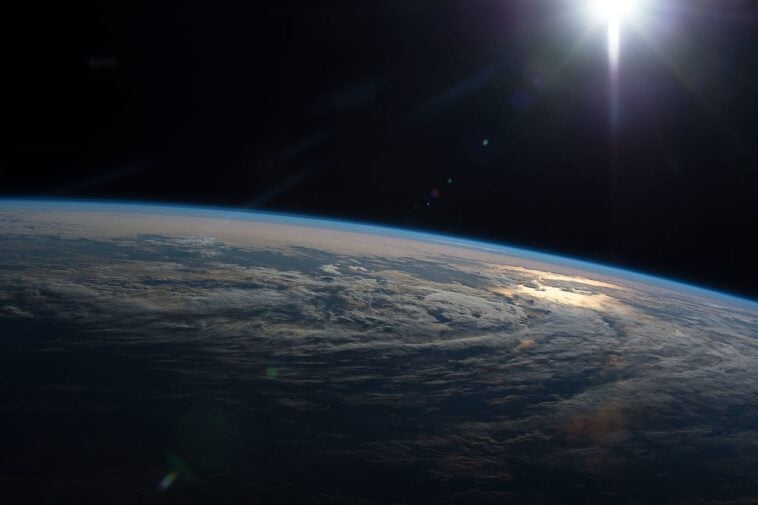
If current scientific models are anything to go by, Earth, now 4.5 billion years old and halfway through its total lifespan, has about a billion years of livable conditions left.
After that, the oceans go, slowly boiled away by an aging, brightening Sun. But the loss of water might not even be the first fatal blow to complex life.
Researchers at Toho University in Japan ran 400,000 climate simulations using NASA planetary models and published the results in Nature Geoscience. Their work paints a grim timeline where the atmosphere could become unbreathable long before the planet is physically destroyed.
As atmospheric chemistry shifts, carbon dioxide levels will plummet, starving plant life and triggering a rapid, permanent collapse of Earth’s oxygen supply.
Our host star dictates the final terms
UC San Diego planetary scientist Keming Zhang—whose recent study in Nature Astronomy analyzed an Earth-like exoplanet orbiting a white dwarf—notes that our timeline is similarly limited, “Planet Earth will only be habitable for around another billion years, at which point Earth’s oceans would be vaporized by the runaway greenhouse effect, long before the risk of getting swallowed by the red giant.”
The mechanics behind Zhang’s warning come down to our host star. The Sun grows about 1% brighter every 100 million years. In a billion years, that’s enough to trigger a runaway greenhouse effect where oceans evaporate, water vapor traps heat, and temperatures climb with nothing to stop them.
While this marks the end for anything living, the dead planet will keep spinning. Earth formed 4.5 billion years ago, but it won’t be until five billion years from now that the Sun runs out of hydrogen fuel, expands into a red giant, and likely takes the planet with it. That’s the end of Earth entirely.
A possible interstellar “Plan B”
This billion-year deadline puts a theoretical expiration date on our stay in the “Goldilocks Zone.” If humanity, or whatever we evolve into, intends to survive, we’re looking at a multi-millennial engineering project.
The discovery of the Earth-like exoplanet orbiting a white dwarf (the leftovers of a dead star) suggests that planets can indeed survive the death of their suns.
Sources: Nature Geoscience, Diario AS, Nature Astronomy, UC Berkeley News