
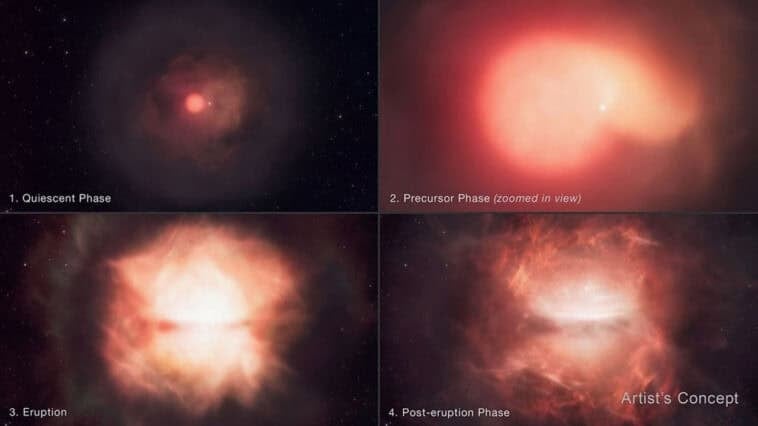
Stars may seem like distant, unchanging points of light, but some of them have surprisingly dramatic endings. Astronomers have now witnessed an extraordinary event in which a massive aging star gradually swallowed its smaller companion, offering the first direct evidence of this rare cosmic phenomenon. But how did scientists catch this incredible event, and what happened to the smaller star? Read on to discover what makes this observation so remarkable.
A rare case of cosmic cannibalism
For decades, astronomers suspected that aging stars could swallow their neighbors whole, though no one had ever caught the process in action. Now, a newly published study in the journal Nature provides the first direct evidence of this extreme phenomenon, occurring 2.5 million light-years away in the Milky Way’s neighboring Andromeda galaxy.
The event unfolded inside a binary star system (a pair of stars locked in orbit around a shared center of gravity) nicknamed “Bao.” As the larger star in the pair neared the end of its life, it entered its red giant phase and ballooned to hundreds of times its original size, spelling doom for its orbiting partner.
Spotting such an engulfment in real time has historically been a monumental challenge for scientists because the early warning signs are easy to miss.
“(It’s) like throwing a bucket of water in a large ocean,” Columbia University astrophysicist Viraj Karambelkar told Space.com (via the New York Post). “We need sensitive telescopes monitoring the sky for a long time in order to catch this effect.”
Spotting a seven-year slow burn
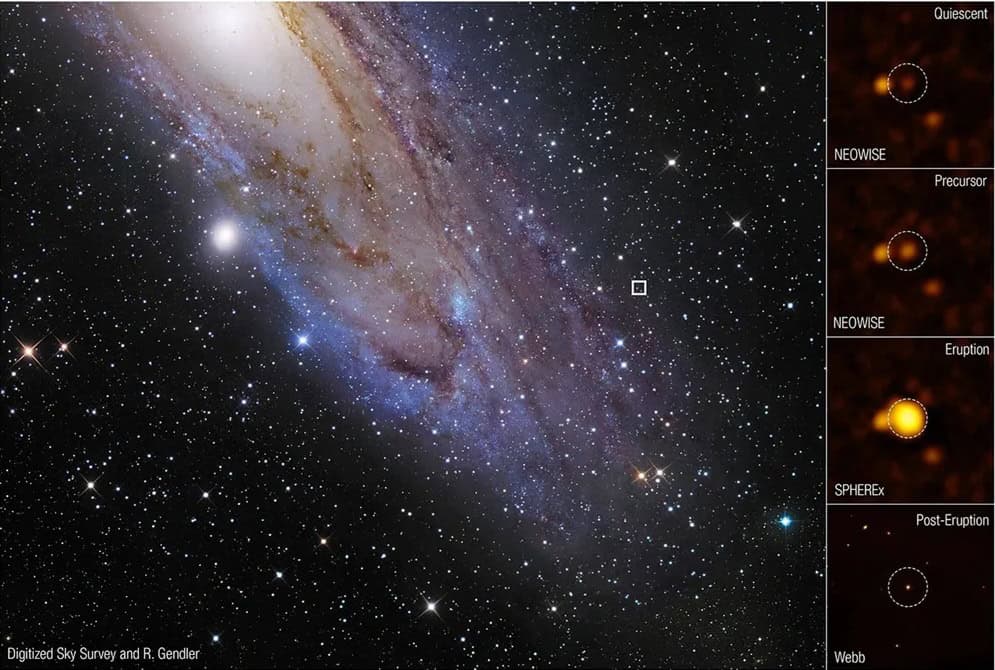
The breakthrough began in 2023 when Karambelkar and his research team noticed an unusual flare-up coming from a red giant designated WNTR23bzdiq. Using NASA’s NEOWISE space telescope alongside the WINTER telescope at California’s Palomar Observatory, the researchers traced the light back through archival data and realized the star hadn’t erupted overnight; it had been steadily growing brighter since 2018.
According to the team’s findings, that seven-year brightening captured the slow, spiraling inward pull of the companion star. As the smaller star plunged through the red giant’s bloated outer layers, the resulting friction generated intense heat and light. In their report, the researchers noted that “these properties of WNTR23bzdiq resemble those of stellar merger transients.”
The slow burn eventually culminated in a massive outburst of light. Just 47 days after the peak eruption, astronomers turned NASA’s James Webb Space Telescope toward the system to examine the aftermath up close. Their analysis suggests the explosion was triggered when the companion star (roughly 70% the mass of our Sun) slammed directly into the red giant’s core, blasting out an amount of stellar material equal to 0.1 to 0.2 times the Sun’s mass.
What happened to the smaller star?
While the discovery turns a decades-old astrophysical theory into an observed reality, the ultimate fate of the smaller star remains an open question.
Karambelkar noted that while the two stars may have fully merged into one, there is another intriguing possibility: both stars could have survived the collision, emerging locked together in a dramatically tighter orbit. Astronomers plan to keep watching the system as the dust settles to see how the survivors behave.
For Karambelkar, this first-of-its-kind observation is just the beginning of a new era in tracking dying stars.
“I can’t wait to find more,” Karambelkar said. “Upcoming telescopes like the Nancy Grace Roman Space Telescope and the Vera Rubin Observatory will be very useful in discovering many more such events.”
Sources:
Nature
Space.com
New York Post