
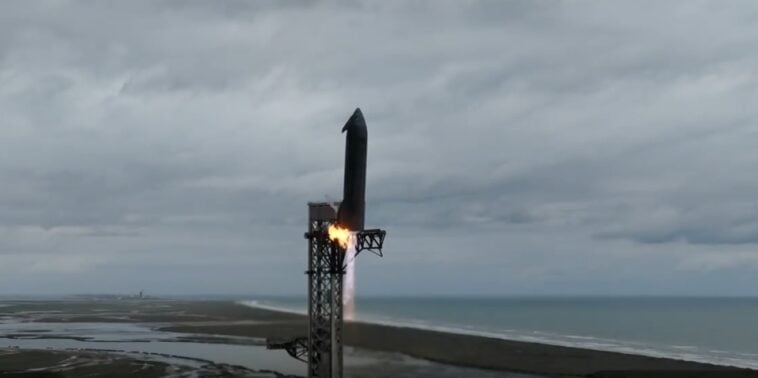
The roar of rocket engines gave way to cheers of excitement and disbelief at Starbase, Texas. On November 14, during SpaceX’s Flight 15 mission, spectators witnessed a first in spaceflight: a rocket’s upper stage returning from orbit with two giant steel arms known as the “chopsticks” catching it in midair.
When the engines shut off, a spacecraft as tall as a 16-story building hung above Orbital Launch Pad 2.
Even on replay, it takes a moment to grasp the scale of this engineering achievement and its ramifications. The precision it took for a roughly 475-foot tower to catch a 171-foot spacecraft returning from orbit is mind-boggling, to say the least.
If SpaceX can recover both stages of its super-heavy-lift rocket and fly them again with minimal refurbishment, Starship could do more to bring down the cost of reaching orbit than NASA’s partially reusable Space Shuttle ever did.
Cheaper launches could also make repeated Moon landings and the many cargo flights needed to build and sustain a lunar base more practical. They could also improve the economics of future missions to Mars.
What is Starship?
Starship is SpaceX’s two-stage super-heavy-lift rocket. The lower stage, Super Heavy, provides the thrust for liftoff while the upper stage carries the payload into orbit. On Flight 15, that spacecraft was Ship 42, which carried a fitting message for fans of Douglas Adams’ sci-fi novel, The Hitchhiker’s Guide to the Galaxy (1979): “Don’t Panic.”
With Ship 42 atop Super Heavy, the complete rocket stood about 408 feet tall.
Starship blasted off from Starbase on November 13. A few minutes later, the stages separated, and Ship 42 continued into orbit under its own power. It deployed 26 Starlink satellites, three of which carried cameras that helped SpaceX assess the ship’s heat shield. Roughly 22½ hours after liftoff, Ship 42 returned to the same launch site.
A belly flop, a flip, and a pinpoint catch
Ship 42 began its atmospheric reentry over the Pacific Ocean at roughly 17,000 mph. Thousands of ceramic tiles protected its steel hull from the heat as the atmosphere slowed it down. As it descended, the ship turned its broad underside into the oncoming air to create drag. Its flaps let it steer while it fell belly-first.
Then came the flip. Close to the ground, three Raptor engines relit and swung the tail down until the ship was upright. With its engines still firing to slow the descent, Ship 42 moved sideways to line up with the open arms of the launch tower, nicknamed Mechazilla.
It eased down the last few feet until the arms took its weight at two small catch points, one on either side of the ship. SpaceX’s flight plan put about 18 seconds between the start of the final engine burn and the catch. The ship did it all without a pilot.
Think of the care it takes to pick up a dumpling without tearing the wrapper. Now imagine the dumpling is nearly 30 feet across and has to fly itself between the chopsticks.
When landing a rocket on a barge was the big story
Audacious catches may soon become routine, much like SpaceX’s early recovery efforts. The company landed a Falcon 9 booster on a floating drone ship for the first time in April 2016. By 2025, Falcon 9 was launching just over three times a week on average, and 157 of its 165 launches used a booster that had flown before.
Taking booster reuse a step further with Starship, SpaceX caught its first Super Heavy booster with a launch tower in Oct. 2024 and had caught three by the time it got to the Flight 15 mission.
The upper stage poses a tougher problem, however. A booster turns back minutes after liftoff, then the ship goes all the way to orbit and has to survive reentry before it gets anywhere near the launch tower.
Flight 15 was designed to tackle both challenges at once, with SpaceX attempting to catch both stages in a single mission. While Super Heavy’s return burn ended early and forced the booster to divert offshore where it was lost, Ship 42 made it home safely the following afternoon.
What those giant chopsticks could save
Unlike Flight 15, which brought its upper stage home, every Falcon 9 launch still discards its upper stage to burn up in the atmosphere. Similarly, NASA’s Space Shuttle fleet was only partially reusable: the agency reused its orbiters and refurbished their solid rocket boosters, but every mission required a new external tank.
If SpaceX can fly both Starship stages repeatedly, it can spread the cost of building the entire rocket across many missions. Catching the ship at the launch site also puts it right where crews can inspect it.
The savings depend on how much time and money it takes to check the engines, replace damaged heat-shield tiles, and get the ship ready for another launch.
If SpaceX can put the same ship back atop a booster and send it to orbit again with relatively little work, this first catch might one day seem as familiar as a rocket landing on a barge.