
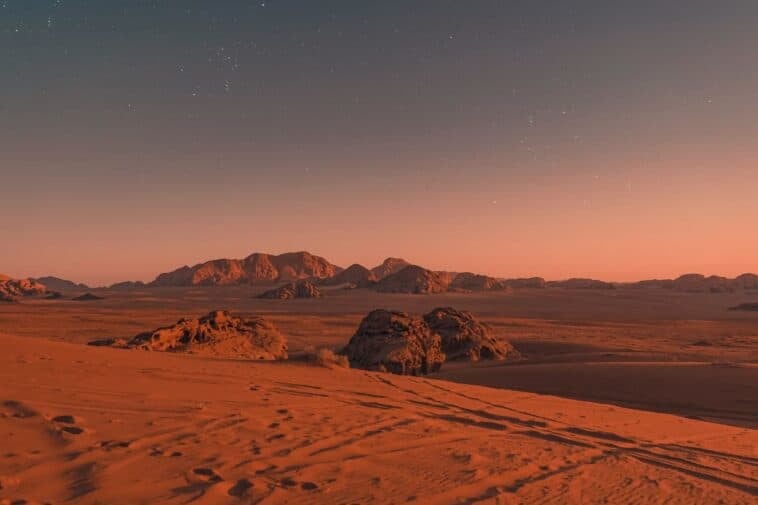
Mars might have a geological secret hiding underneath all that red dust. Scientists studying the planet have discovered mysterious volcanic gas appearing above cracks near one of its enormous volcanoes, raising the possibility that Mars still has underground magma and volcanic activity today.
The discovery comes from the European Space Agency’s ExoMars Trace Gas Orbiter (TGO), which detected unusual concentrations of hydrogen chloride above fractures in the Alba Mons volcanic region. Hydrogen chloride is particularly interesting because volcanoes on Earth commonly release it through openings connected to magma. And on Mars, the gas keeps showing up in a place and season where scientists normally wouldn’t expect it.
The research, published in Science Advances, does not confirm that Mars is currently erupting. But it offers some of the strongest evidence yet that the Red Planet might not be as volcanically dead as previously assumed.
Mars has a gas issue
Hydrogen chloride normally follows a seasonal pattern on Mars. Its concentrations tend to rise during northern winter and decline to extremely low levels during summer, largely because of the planet’s dust and water cycles.
But something unusual happens around Alba Mons. During early northern summer, the Trace Gas Orbiter repeatedly detected elevated hydrogen chloride over the same volcanic fractures. The gas appeared in the same location even when its seasonal behavior suggested it should be disappearing.
According to the researchers, the gas could be escaping from underground volcanic systems through cracks in the Martian surface. If that’s what’s happening, Mars may still have enough internal heat to support volcanic processes beneath its crust.
Daniel Mège, a co-lead author of the study from the Space Research Centre of the Polish Academy of Sciences, said the findings suggest Mars retained enough internal heat to support volcanic activity until relatively recently, and potentially still does.
The spacecraft found a volcanic smoking gun
Beyond detecting a few molecules of gas floating around Mars, researchers also examined images of the region captured by the Trace Gas Orbiter’s CaSSIS camera. Those observations revealed narrow fractures cutting through the surface, some extending hundreds of meters. The cracks appeared relatively fresh on geological timescales, with unusual discoloration around parts of the fractured terrain.
That combination of gas emissions, surface fractures and localized changes in color gave scientists a much stronger clue about what might be happening. On Earth, volcanic gas vents known as fumaroles release gases from underground volcanic systems even when a volcano isn’t actively erupting lava.
The team thinks something similar could be happening on Mars. During the planet’s extremely cold winters, ice may seal the fractures and prevent gases from escaping. When summer arrives, that ice sublimates, potentially reopening pathways for gases from underground. The escaping material could also leave mineral deposits behind, explaining some of the unusual discoloration around the cracks.
Alba Mons might not be finished yet
Mars is already home to the largest volcanoes in the Solar System, including Olympus Mons and the enormous volcanic structures across the Tharsis region. But scientists have spent decades trying to figure out whether any of them remain active.
Orbital images suggest some Martian volcanoes experienced eruptions within the past few million years. NASA’s InSight lander also recorded Marsquakes, demonstrating that Mars still experiences seismic activity.
Computer simulations have even suggested that heat rising from deep inside the planet could potentially melt rock beneath parts of the Tharsis volcanic plateau. Still, nobody has directly witnessed a fresh Martian eruption or a new lava flow. Instead of searching for a dramatic plume of smoke or molten rock pouring down a mountainside, scientists may have found evidence of a quieter kind of volcanic activity happening beneath the surface.
Keep in mind that volcanoes don’t always release the same gases in the same quantities. Even after an eruption ends, some volcanic systems can continue releasing hydrogen chloride while producing little sulfur dioxide, another gas scientists commonly look for when investigating volcanic activity. So the absence of one familiar volcanic gas doesn’t necessarily mean Mars has stopped producing them altogether.
Could these cracks hide Martian life?
If volcanic systems are still active beneath Alba Mons, they could potentially create hydrothermal environments where underground water interacts with heat from magma. On Earth, hydrothermal systems can support microorganisms without relying on sunlight. Instead, those organisms use chemical energy from their surroundings.
Such environments could also offer protection from Mars’ extremely hostile surface conditions, including intense radiation and dramatic temperature swings.
Daniel Mège believes investigating the gas-emitting fractures could make sense in the search for Martian life. If hydrothermal systems exist there, they might provide the ingredients, energy and protection needed for microorganisms to survive.
Mars might be more alive geologically than we thought
The Trace Gas Orbiter’s discovery could change how scientists think about Mars’ geological history and present-day activity. If the hydrogen chloride really comes from underground magma, it would suggest that the planet still retains enough internal heat to support volcanic processes long after its most dramatic eruptions ended.
It could also help researchers understand how volcanic gases once contributed to Mars’ atmosphere, potentially influencing the planet’s ancient climate and conditions for liquid water. For now, the researchers still need more evidence to confirm exactly where the gas originates and whether magma is actively moving beneath the surface.
But Mars has spent years looking like a planet whose geological excitement ended billions of years ago. Turns out, it might just have been keeping some of the interesting stuff underground.
Sources: ScienceDaily, Mashable