
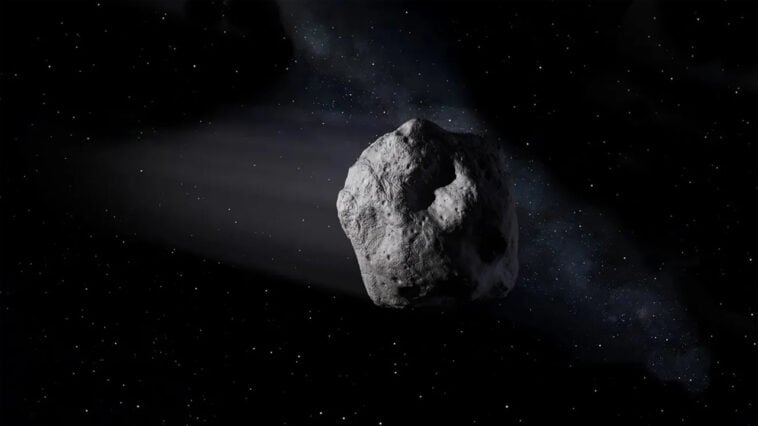
Don’t blink, or you might just miss Earth’s newest natural satellite. Astronomers have officially confirmed that a tiny, near-Earth asteroid has been swept up by our planet’s gravity, granting us a rare and fascinating “mini-moon.” But this cosmic arrangement is strictly short-term: in just a few weeks, gravitational forces will fling our temporary celestial roommate back into deep space, making now the only chance to discover where it came from and what its brief visit reveals about our solar neighborhood.
Earth’s fleeting new neighbor
Long before astronomers caught sight of it, a tiny piece of the cosmos was quietly sneaking into our neighborhood. Back on August 20, 2026, astronomer Krisztián Sárneczky spotted a small space rock near Earth, an observation formally logged by the Minor Planet Center on October 29.
Calculations show that this object didn’t just pass by; it actually entered a temporary orbit around our planet way back in April. Measuring only about 3 feet (1 meter) across, the visitor has been dubbed 2026 QQ8.
If you are worried about an impending cosmic collision, you can rest easy. At its closest approach, 2026 QQ8 will remain roughly 0.0038 astronomical units (AU) away from us. To put that into perspective, that is about 1.5 times farther away than our permanent Moon is. Even if it were on a collision course, its diminutive size means it would simply burn up as a brilliant shooting star in Earth’s atmosphere rather than pose any threat to the surface.
Asteroid or space junk?
When a strange object pops up near Earth, scientists always have to ask a crucial question: Is it a natural asteroid, or is it a piece of human-made debris, like an old rocket booster or discarded satellite?
To solve the mystery, astronomers turned their lenses toward the sky, using the University of Hawaii 2.2-meter telescope and the Lowell Discovery Telescope for rigorous follow-up observations. Their data confirmed the exciting truth: 2026 QQ8 is entirely natural, ruling out space junk and cementing its status as an authentic asteroid.
Why is 2026 QQ8 only a mini-moon?
Earth’s newest companion isn’t here to stay. After getting swept up in our gravity in late April, it is slated to hang around through December before continuing on its own independent journey through the solar system in 2027.
By analyzing orbital data, astronomers have mapped its larger routine. 2026 QQ8 makes a close pass by Earth roughly every 10 years. It made a relatively close approach back in 1965, though not quite close enough to be captured, and is projected to swing by again in 2058 without becoming a mini-moon.
Why did it get captured this time? The secret lies in a region of space known as the Hill sphere (or Hill radius), which is the zone around a planet where its own gravity is stronger than the pull of the Sun. Outside of this boundary, the Sun dictates how objects move. But when 2026 QQ8 crossed inside Earth’s Hill sphere in April, our planet’s gravity temporarily reeled it in, creating a chaotic, looping dance that looks nothing like the neat, circular orbit of our permanent Moon.
A growing family of temporary moons
As it turns out, Earth frequently plays host to short-term space rocks. Previous mini-moon visitors have included:
- 2020 SO
- 2020 CD3
- 2024 PT5
- 2025 PN7 (technically a “quasi-moon”)
If you are wondering what sets a quasi-moon apart, it all comes down to how it moves. A quasi-moon doesn’t actually orbit Earth; rather, it shares a very similar orbit around the Sun alongside us. Because its path isn’t an exact match to ours, our perspective makes it look like it’s looping around us — shifting positions so that it sometimes appears ahead of Earth and sometimes trails behind.
For now, though, 2026 QQ8 holds a true mini-moon status, giving science a front-row seat to a brief, beautiful cosmic rendezvous before it fades back into the dark expanse of space.
Source:
EarthSky