
For decades, archaeologists have excavated the sun-baked layers of Egypt’s historic Nile Delta, assuming they had uncovered everything this legendary ancient site had to offer. But as it turns out, history was keeping a massive secret just beneath their boots. Thanks to high-tech satellite scans from space, scientists have mapped a colossal, 2,600-year-old religious complex concealed deep beneath the modern landscape. Keep reading to find out what the team discovered and what this subterranean sanctuary reveals about Egypt’s past.
Piercing the silt of the Nile Delta
For more than 5,000 years, the ancient city of Buto, known today as Tell al-Fara’in or the “Mound of the Pharaohs”, has held a central place in Egyptian history. Long revered as the sacred domain of Wadjet, the cobra goddess who protected Lower Egypt and its pharaohs, the city was once a bustling political and spiritual sanctuary.
Yet, for several years, modern archaeologists faced a frustrating barrier. Because Buto was continuously inhabited across multiple eras, newer construction and centuries of mud, silt, and clay buried its oldest secrets. Deep underground deposits dipping below the natural water table made traditional shovel-and-trowel digging nearly impossible without destroying the layers above.
Now, a team of Egyptian researchers has bypassed the mud entirely by peering into the earth from space.
High-tech scans unveil a lost sanctuary
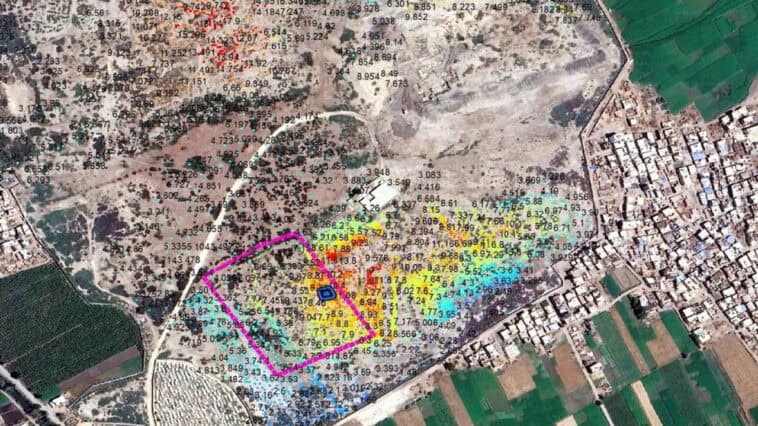
Using radar imagery from the European Space Agency’s Sentinel-1 satellite, scientists detected a massive, oval-shaped pattern hiding under a mound known as Kom C. Measuring roughly 420 feet long by 203 feet wide (128 by 62 meters), the hidden footprint pointed to a colossal structure buried deep underground.
To confirm what the satellite saw from orbit, researchers deployed electrical resistivity tomography, a non-invasive technique that maps hidden structures by sending electrical currents through the ground via hundreds of metal electrodes.
By measuring how the current moved through different underground layers along 15 survey lines, the team built a precise 3D model of the buried landscape. The scans revealed a massive mudbrick wall buried 10 to 20 feet (3 to 6 meters) beneath the surface, resting on a deep, engineered sand foundation.
Unearthing the sacraments of the Saite period
To verify the electronic map, researchers excavated a targeted trench measuring 33 by 33 feet and dug down more than 20 feet. What they found confirmed the high-tech readings: thick mudbrick walls and an array of intact sacred artifacts.
Among the items recovered were ceremonial amulets depicting Egyptian deities, including Wadjet herself, and a small stone offering basin.
The artifacts and structural scale suggest the site was a major religious complex, potentially serving as:
- A secondary temple or shrine dedicated to local worship
- A residence and administrative center for high priests
- A specialized facility for religious services or funerary rites
Publishing their findings in the journal Acta Geophysica, the research team dates the structure to between the late 8th century BCE and the Saite Period (the 26th Dynasty, spanning the 7th and 6th centuries BCE).
Rewriting the timeline of an ancient center
The discovery offers crucial insight into one of the most enigmatic chapters in the Nile Delta’s history.
Following the collapse of Egypt’s Old Kingdom, Buto suffered a mysterious, 1,500-year period of abandonment where the city sat largely silent. It was not until the Third Intermediate Period and the subsequent Saite Renaissance that life returned in full force.
This newly mapped complex stands as concrete evidence of that grand revival, proving that during the 26th Dynasty, Buto was once again a thriving center of regional power and divine devotion. With vast layers of the settlement still unexplored beneath the groundwater, scientists believe this massive temple complex is only the first of many monumental structures waiting to be brought back into the light.
Sources:
Acta Geophysica Journal
Gizmodo