
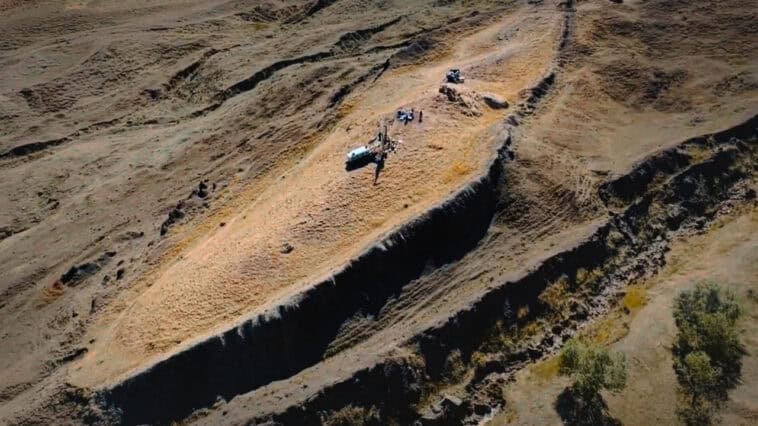
For centuries, the story of Noah’s Ark has lived on as one of history’s greatest enduring mysteries, but a stunning discovery in Turkey might finally turn legend into reality. Researchers utilizing advanced underground scanning and excavation techniques have uncovered charred, wood-like material buried an astonishing 30 feet beneath the surface at the famous Durupınar site near Mount Ararat. Could this subterranean anomaly truly be the remnants of the biblical vessel, or is it just another geological puzzle? Keep reading to uncover the evidence behind the dig, what the carbon testing could mean, and why scientists are suddenly paying very close attention.
Wood-like material found beneath suspected Noah’s Ark site
The search for Noah’s Ark has taken another intriguing turn, with researchers reporting that they have found charred and unburned wood-like material buried nearly 30 feet underground at a site in eastern Turkey. The discovery could offer new clues about the mysterious formation, although there is no conclusive evidence that it is connected to the biblical vessel.
The material was reportedly found at the Durupınar Formation, a geological structure measuring approximately 538 feet long near Mount Ararat. Since its discovery in 1959, the site has attracted attention from Ark hunters because of its unusual, ship-like shape and location near the region traditionally associated with the biblical account.
According to the Bible, Noah built a massive vessel to protect his family and representatives of the world’s animals from a catastrophic flood. The story has inspired centuries of searches for physical evidence that the Ark existed.
Andrew Jones, founder of Noah’s Ark Scans and the project’s lead researcher, told the Daily Mail that his team discovered wood both with and without signs of burning deep beneath the surface. Jones suggested the charred material could potentially be “the charred remains of Noah’s Ark.”
However, the findings have not established that the material came from the biblical vessel, and further testing will be needed to determine its age and origin.
Could fire have helped preserve the remains?
The researchers have yet to determine how the wood became charred. Jones suggested that the material might be linked to a campfire lit by a shepherd seeking shelter at the site hundreds of years ago. Other possible explanations include a lightning strike or a volcanic eruption, though none has been confirmed.
The possibility of burning is particularly interesting because the biblical account describes Noah coating the Ark with pitch, a substance used to waterproof wooden surfaces that is also highly flammable.
According to the researchers, exposure to fire may have slowed the wood’s decomposition, potentially helping preserve some of the material underground. However, this remains a theory rather than a confirmed explanation for the condition of the samples.
The reported discovery adds to a growing collection of findings that the team believes could support the idea that the Durupınar Formation is more than a naturally occurring geological structure.
Underground scans reveal possible chambers and tunnels
In previous investigations, Noah’s Ark Scans used ground-penetrating radar to examine the formation’s interior. The team reported finding what it interpreted as a network of underground chambers and tunnels whose dimensions appeared consistent with descriptions of the Ark in the Bible.
The researchers also identified a larger central cavity, which Jones named the “Atrium.” He believes the alleged interior spaces could help explain how the vessel might have accommodated Noah, his family, and the animals described in the biblical story.
However, radar scans alone cannot establish that the underground features are man-made or that they belong to an ancient ship. Independent investigation would be needed to verify the team’s interpretation of the structures.
Soil samples offer another potential clue
The researchers have also pointed to differences in soil composition as a possible indication that the formation deserves further study.
According to their analysis, soil collected from inside the structure contained three times as much organic matter and 38% more potassium than samples taken from outside it. The team believes these differences could be consistent with the presence of decaying organic material.
Jones said the investigation gained another potential lead during a drilling and scanning expedition in the fall. The team reported finding rich, black soil beneath the formation rather than the natural bedrock that critics have suggested could explain its structure.
The researchers plan to examine the soil for evidence of decomposed wood and other materials that might help establish the site’s history.
“Noah’s Ark was a giant wooden boat, according to the Bible,” said Jones. “As wood decays, you’re gonna find elevated organic matter.”
These findings could help guide further research, but differences in soil composition do not, by themselves, prove that a wooden vessel once occupied the site.
Will testing finally solve the Noah’s Ark mystery?
The next major step is determining the age and composition of the recovered material. Carbon dating could help establish when any organic samples originated, potentially revealing whether they date to the period traditionally associated with the biblical flood or to a much more recent time.
Even if testing confirms that the material is ancient wood, researchers would still need to establish whether it came from a boat and whether the formation contains evidence of human construction. Geological processes can create unusual landforms, and the Durupınar Formation’s ship-like appearance has long been a point of debate.
For now, the reported discovery offers another reason to investigate the site, but it does not settle the question of whether Noah’s Ark has been found. Further testing and independent scientific scrutiny will be essential before the claims can be confirmed.
Sources:
The Daily Mail
New York Post