
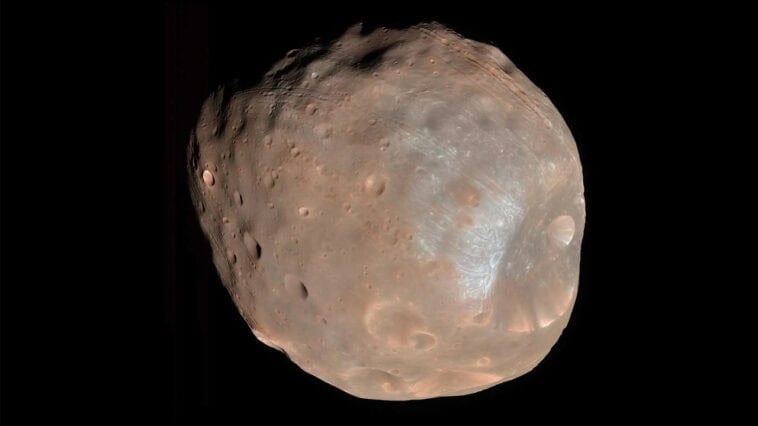
Mars has two small moons, Phobos and Deimos, but scientists are still trying to solve the mystery of their origins. Now, Japan is pursuing an ambitious space mission to collect samples from one of them and bring the material back to Earth for closer study. Researchers hope the mission will uncover clues about how these moons formed and whether they are captured asteroids or remnants of a much larger collision. But what secrets could these tiny, mysterious worlds reveal about Mars and the early solar system? Keep reading to find out what researchers hope to uncover.
A historic journey to Phobos
Japan is preparing to investigate one of Mars’s biggest unanswered questions: how its two small moons came to exist. The Japan Aerospace Exploration Agency (JAXA) is leading the Martian Moons eXploration (MMX) mission, which aims to collect samples from Phobos and return them to Earth for detailed analysis.
The spacecraft is scheduled to launch aboard Japan’s H3 rocket and spend about five years traveling to Mars, studying its moons, and bringing samples home. The mission comes as the United States, China, and other countries explore plans for future crewed missions to the Red Planet.
MMX project manager Yasuhiro Kawakatsu said the samples could also help scientists assess whether a Martian moon could serve as a base for future human exploration.
“Despite their potential importance, Martian moons have never been fully investigated,” Kawakatsu said. “They are known as the most important unclimbed mountains in the solar system.”
Japan is leading the international effort, with NASA and other space agencies contributing scientific instruments and communications support.
Scientists are still unsure how Mars’ moons formed
Although dozens of spacecraft have visited Mars since the 1960s, its moons remain poorly understood. Phobos and Deimos are both irregularly shaped, crater-covered objects, and researchers have yet to agree on where they came from.
One theory suggests the moons formed from debris thrown into space when a large object struck Mars. Another proposes that they are asteroids captured by the planet’s gravity.
MMX principal investigator Kiyoshi Kuramoto believes studying Phobos directly could help settle the debate.
“We can almost certainly come to a conclusion by analyzing (Phobos) soil samples,” Kuramoto said.
Scientists selected Phobos as the main sampling target because it orbits closer to Mars than Deimos. Researchers also expect the collected material to contain a small amount of Martian debris, potentially offering additional information about the planet itself.
A five-year journey to the Martian system
The MMX spacecraft is expected to reach the Mars system in August 2027, after traveling hundreds of millions of kilometers through space. Although Mars can come within about 55 million kilometers (34 million miles) of Earth, the spacecraft’s actual route will be considerably longer.
Once it arrives, MMX will study Phobos for several years before beginning its journey home. The mission consists of three main modules responsible for propulsion, exploration, and returning the samples to Earth.
The spacecraft carries 13 instruments, including cameras, scientific equipment, and a radiation monitor that could help researchers prepare for future human missions to Mars. NASA is contributing a sampling device, while European partners have supplied equipment and communications technology.
The mission also includes Idefix, a small rover developed jointly by France and Germany. It will examine Phobos’ surface and help scientists identify suitable locations for collecting samples.
How will Japan collect samples from Phobos?
Idefix is expected to explore Phobos for about 100 days around 2028 or 2029. Its observations will help the MMX spacecraft select a relatively flat, safe landing site.
Japan aims to collect at least 10 grams (0.35 ounces) of material from two sampling attempts. The spacecraft will use two methods to gather the precious material.
- Gas-powered sampling: A NASA-provided device will use pressurized gas to lift surface dust into a collection container.
- Coring tool: A Japanese device will collect material from beneath the surface, reaching approximately 2 centimeters (less than 1 inch) deep.
By gathering material from different depths, scientists hope to compare surface dust with material that has been less exposed to the space environment.
The samples will be sealed inside a special capsule carried by the spacecraft’s return module. If everything goes according to plan, the capsule will reach Earth in 2031, allowing researchers to examine the material in laboratories.
Landing on Phobos presents a major challenge
Collecting samples from Phobos will not be easy. The moon has only about one two-thousandth of Earth’s gravity, making it difficult for a spacecraft to land without bouncing off the surface.
Its rugged terrain and numerous craters add another complication. The spacecraft must identify a suitable landing site and complete its sampling operations within roughly two hours.
To reduce the risk of bouncing, MMX features four-legged landing gear designed to absorb the impact of touchdown. Meanwhile, Idefix has specially designed wheels to maintain traction in the moon’s weak gravity and recover if it tips over.
JAXA says the rover will move “at a snail’s pace,” reflecting the need for careful navigation in such an unfamiliar environment.
If successful, the mission could finally reveal whether Phobos and Deimos are captured asteroids or remnants of an ancient collision. Beyond solving that mystery, the findings could deepen scientists’ understanding of how planets and moons formed, and help prepare humanity for future exploration of Mars.
Source:
AP News