
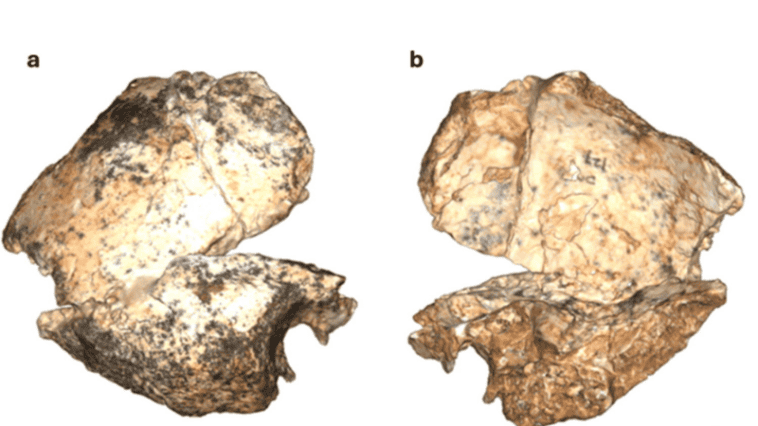
Newly analyzed fossils from a South African cave suggest that Homo erectus, an early human species believed to be our direct ancestor, was living in southern Africa about 2 million years ago.
The new adult specimen is roughly 200,000 years older than other known adult Homo erectus fossils (the species’ presence at this early date was first indicated by a child specimen reported at the same site in 2020).
Researchers from La Trobe University, working with colleagues in South Africa and the United States, reached the conclusion after describing 18 previously unstudied hominin fossils from Drimolen Main Quarry in the Cradle of Humankind, a UNESCO World Heritage site near Johannesburg.
Although teams excavated the site continuously from its discovery in 1992 until 2019, many of the fossils they uncovered sat safely in storage for years and had never been formally studied.
The findings of these newly described cranial and mandibular remains were published in Annals of Human Biology.
A tale of two contemporaries
The most important specimen that was identified is DNH 127, part of an adult Homo erectus skull. It is the first adult fossil of the species found at Drimolen and is about 2 million years old, roughly 200,000 years older than adult Homo erectus fossils from other sites, including Dmanisi in Georgia that date to about 1.8 million years ago.
Drimolen had already yielded an earlier Homo erectus fossil, DNH 134, but that specimen came from a child between two and four years old.
“Homo erectus is the first species of hominin that researchers broadly agree fits within our own genus Homo and is likely directly ancestral to us,” said lead researcher Dr. Jesse Martin in a statement. “This paper publishes a new adult fossil attributed to Homo erectus, DNH 127, providing further confirmation that this species first appeared in southern Africa 2 million years ago,” Martin added.
Most of the remaining fossils belong to Paranthropus robustus (a few could not be assigned to a species), a human relative that shared the same landscape.
While Homo erectus was developing a larger brain and smaller molars, possibly because they ate more meat, P. robustus retained a brain only slightly bigger than a chimpanzee’s and evolved very large molars for grinding tough food.
And at Drimolen, P. robustus was far more common.
“2 million years ago P. robustus outnumbered Homo erectus at Drimolen by more than 10 to one,” Martin noted. “During this time period, it was our ancestors that looked like the outside long-odds chance to survive,” Martin added, a retrospective view, considering Homo erectus ultimately emerged as the successful evolutionary lineage.
The fossils also show P. robustus changing over time. Compared with fossils from Swartkrans cave, which are about 1.8 million years old, the Drimolen specimens have smaller teeth and weaker chewing muscles, evidence that both features grew larger over roughly 200,000 years.
These differences helped researchers classify the Drimolen population as a distinct subspecies, P. robustus ukusa. The newly analyzed fossils further support that designation.
Sources: La Trobe University, Annals of Human Biology, Science Daily