
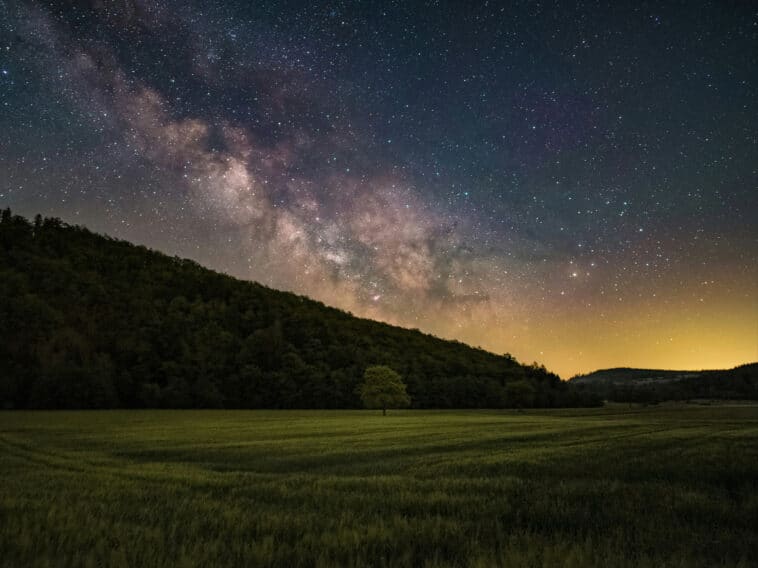
Almost gone are the days when looking up at the night sky actually meant seeing a lot of stars. A study found that the brightness of the night sky increased by an average of 9.6% every year between 2011 and 2022. At that rate, the sky’s artificial glow roughly doubles every eight years. About 80% of people worldwide live under light-polluted skies, meaning the Milky Way is basically invisible from where most humans live.
The problem is not just city lights anymore.
Earth is getting brighter after dark
LED streetlights, parking lots, buildings, sports fields and giant outdoor signs have transformed nighttime landscapes. The result is something called skyglow: artificial light bouncing and scattering through the atmosphere, creating a bright haze that washes out faint stars.
You can switch off every light in your bedroom and still have a glowing orange-white sky outside your window. This is a problem, and it’s not just for stargazing. Animals need it, too.
Baby sea turtles can mistake artificial lights for the moonlit ocean and head toward parking lots instead. Moths can become trapped circling light sources, and migrating birds can become disoriented by brightly lit cities. Even plants aren’t getting a free pass. Research has linked artificial nighttime light to changes in plant-pollinator relationships and shifts in when trees flower.
Humans are part of the same ecosystem. Artificial light at night can interfere with circadian rhythms, the internal biological clock that helps regulate sleep and other body functions.
The stars aren’t the only things crowding the sky
Even if you escape the city and find a genuinely dark location, satellites pose another problem. The growing number of commercial satellites has made bright moving objects increasingly common in night-sky observations.
Starlink alone has more than 11,000 satellites in orbit, and satellite constellations can interfere with astronomical observations and change the appearance of the night sky. There are even proposals now for satellites that could reflect sunlight toward Earth to illuminate areas at night.
Some cities are fighting back
The good news is that communities do not necessarily have to choose between functioning streets and completely dark cities. Flagstaff, Arizona, has regulated outdoor lighting since 1958 and became the first officially recognized Dark Sky City in 2001. Its rules address how much artificial light can be used, what type of lighting is allowed and where that light can point.
As opposed to turning everything off, the idea is for people to use only as much light as they actually need. That can mean warmer-colored lighting, shielded fixtures that point downward instead of into the sky, fewer unnecessary lights and lower brightness where possible. New York state is also considering legislation aimed at protecting dark skies. Those local rules, however, can’t do much about satellites overhead.
Sources: The Guardian, Root Nation