
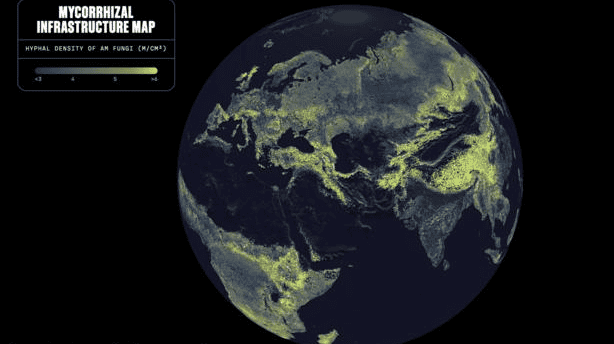
There are about ten meters of living fungus in a teaspoon of good soil. Add up every teaspoon in Earth’s topsoil, and the thread runs roughly 110 quadrillion kilometers, long enough, stretched end to end, to reach the Sun hundreds of millions of times.
The numbers come from the first global map of arbuscular mycorrhizal fungi, published recently in the research journal Science by a team at the Society for the Protection of Underground Networks (SPUN).
The fungi themselves never pop up as mushrooms. They’re microscopic tubes winding through the dirt and plugging straight into plant roots. In return for carbon from the plant, they supply water and minerals. Around 70 percent of land plants rely on this arrangement, a partnership that’s lasted for about 475 million years.
No one actually measured every bit of the 110-quadrillion-kilometer network, of course. The team compiled data from more than 16,000 soil cores across hundreds of studies and let machine learning fill in the gaps of what had not been sampled. Led by SPUN’s Dr. Justin Stewart and Dr. Corentin Bisot of the AMOLF institute in Amsterdam, the project found that grasslands carried the heaviest load, holding around 40 percent of the entire network.
Across every ecosystem, these fungi draw down something like 4 billion tonnes of CO₂ equivalent a year into the soil, which is about 11 percent of what humans typically emit. Some of the thickest patches sit under the Everglades in southern Florida and the Tibetan Plateau, yet most of that ground has no protection. A 2025 SPUN analysis even found that 95 percent of the richest hotspots lie outside protected areas.
Farms are rough on the network. Cropland holds only about half the fungus of the wild ground it replaced, largely because tilling tears the threads apart. Fertilizer, meanwhile, does its damage more quietly.
Feed a plant phosphorus out of a bag, and it stops trading with the fungus that once supplied more than 80 percent of its phosphorus. And when you keep the fertilizer coming, the crop never notices what’s missing.
The disruption is widespread. Grassland is also being plowed under about four times faster than forests are being cut. Even so, the living network that remains still weighs around 300 megatons of carbon, which is several times heavier than every person alive put together.
The map itself is limited and only counts one kind of fungus. This is because pines and oaks depend on a different underground system entirely, and the decomposer fungus forms yet another. Neither has a comparable global figure, however.
Toby Kiers, SPUN’s executive director, described the work to The Guardian as one of the most exciting studies of her career. The data are intended to help governments and conservation groups identify where the underground networks are densest and where they remain least protected.
Sources: Science, Eureka Alert!, SPUN Explainer, Space Daily, The Guardian