
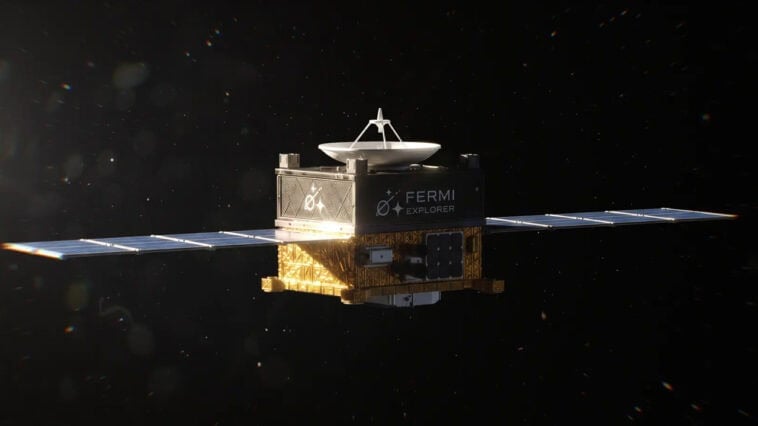
Humanity is preparing to send a spacecraft to another star — but reaching its destination won’t happen anytime soon. Set to launch in 2029, the tiny probe will begin a journey so long that 80,000 years could pass before it arrives. It is a journey so vast that scientists predict modern humans will eventually build faster spacecraft, overtake the probe, and be waiting to welcome it when it finally completes its cosmic trek. So where exactly is this spacecraft going, why will the journey take so incredibly long, and why send a craft on a journey destined to be surpassed? Here’s what makes this extraordinary voyage unlike any space mission before it.
Fermi Explorer Mission sets its sights on Alpha Centauri
A U.S.-based nonprofit organization is proposing an ambitious first step toward interstellar exploration: sending a spacecraft toward another star.
The project, called the Fermi Explorer Mission, is targeting the Alpha Centauri star system, our nearest neighboring stellar system. But unlike many interstellar concepts that aim to reach another star within a human lifetime, this mission is designed around a far more distant future.
The probe is expected to launch in 2029 and carry about one kilogram of payload, including a copy of the Golden Records originally placed aboard NASA’s Voyager spacecraft. Private supporters who help finance the mission’s $15 million price tag would also have the opportunity to place their initials, names, or even small objects aboard the spacecraft.
Yet the most unusual part of the proposal is not its destination or its price. It is what the team expects to happen long after the spacecraft leaves Earth.
The organization believes humans will eventually develop much faster spacecraft and overtake the original probe during its 80,000-year journey. By the time the tiny spacecraft reaches Alpha Centauri, humanity could already have arrived there.
In the mission’s promotional vision, the probe is eventually passed by increasingly advanced human spacecraft before reaching its destination, where it is greeted by a vast ring world.
That vision extends far beyond a single spacecraft. The team presents the mission as a possible opening move in humanity’s eventual expansion across the Milky Way and, ultimately, beyond our own galaxy.

An old idea with a very different approach
The Fermi Explorer Mission is not the first serious proposal to send a spacecraft to another star.
Its choice of Alpha Centauri is reminiscent of Breakthrough Starshot, an interstellar project announced more than a decade ago. That initiative proposed using extremely small spacecraft equipped with light sails and accelerating them to roughly 20% of the speed of light.
At that speed, tiny probes could theoretically reach Alpha Centauri in around 20 years. Because the spacecraft would perform a rapid flyby rather than enter orbit, any information they collected would still take additional time to travel back to Earth.
The Fermi Explorer Mission takes a dramatically different approach. Instead of attempting to make the trip within decades, it accepts an extraordinarily long travel time in exchange for a much less demanding mission concept.
An AI-designed route around the Sun
One of the biggest challenges facing the mission was its budget.
The team told Technology Review (via Heise Online) that it had spent about a year trying to determine how the proposed spacecraft could be built and launched for roughly $15 million. The breakthrough came from an artificial intelligence system that identified a different way of planning the spacecraft’s trajectory.
Rather than relying on a more conventional direct route, the proposed spacecraft would make repeated close approaches to the Sun to gain speed.
According to the mission plan, the probe would use the Sun for four separate gravity-assist maneuvers, approaching the star closer than Mercury does. These encounters would allow the spacecraft to build up momentum without requiring it to carry enormous quantities of fuel.
The approach could also reduce the spacecraft’s size and mass. Because the mission would rely less heavily on onboard propulsion, its solar panels could be smaller, helping keep the overall vehicle lightweight.
That lighter design is crucial to making the mission affordable.
The resulting trajectory may not produce a record-breaking arrival time, but that is not the project’s primary goal. The objective is to get humanity’s first dedicated interstellar probe on its way.
The Fermi Paradox behind the mission
The mission’s name is also a reference to one of the biggest unanswered questions in the search for extraterrestrial life: the Fermi Paradox.
The paradox is associated with physicist Enrico Fermi and centers on a deceptively simple question: If intelligent life should be relatively common across the universe, why have we seen no convincing evidence of extraterrestrial civilizations?
There are numerous possible explanations. The Fermi Explorer Mission groups them into several broad possibilities.
One is that intelligent life capable of developing advanced technology may be extraordinarily rare. Another is that civilizations may exist for only a relatively short period before disappearing.
There is also the possibility that advanced civilizations deliberately avoid revealing themselves. Alternatively, perhaps intelligent life is common but, for some fundamental reason, cannot spread beyond its home star.
The proposed mission is intended to explore part of that larger question by demonstrating that an intelligent species can at least begin the process of reaching another star.
What an interstellar launch could prove
Simply sending a spacecraft toward another star would not prove that extraterrestrial civilizations exist. Instead, the mission is designed around a more basic question: Is interstellar expansion something an intelligent species can actually begin?
If humanity launches a probe specifically intended to reach another star, it would demonstrate that an intelligent species does not necessarily have to remain permanently tied to its home system.
Source:
Heise Online